
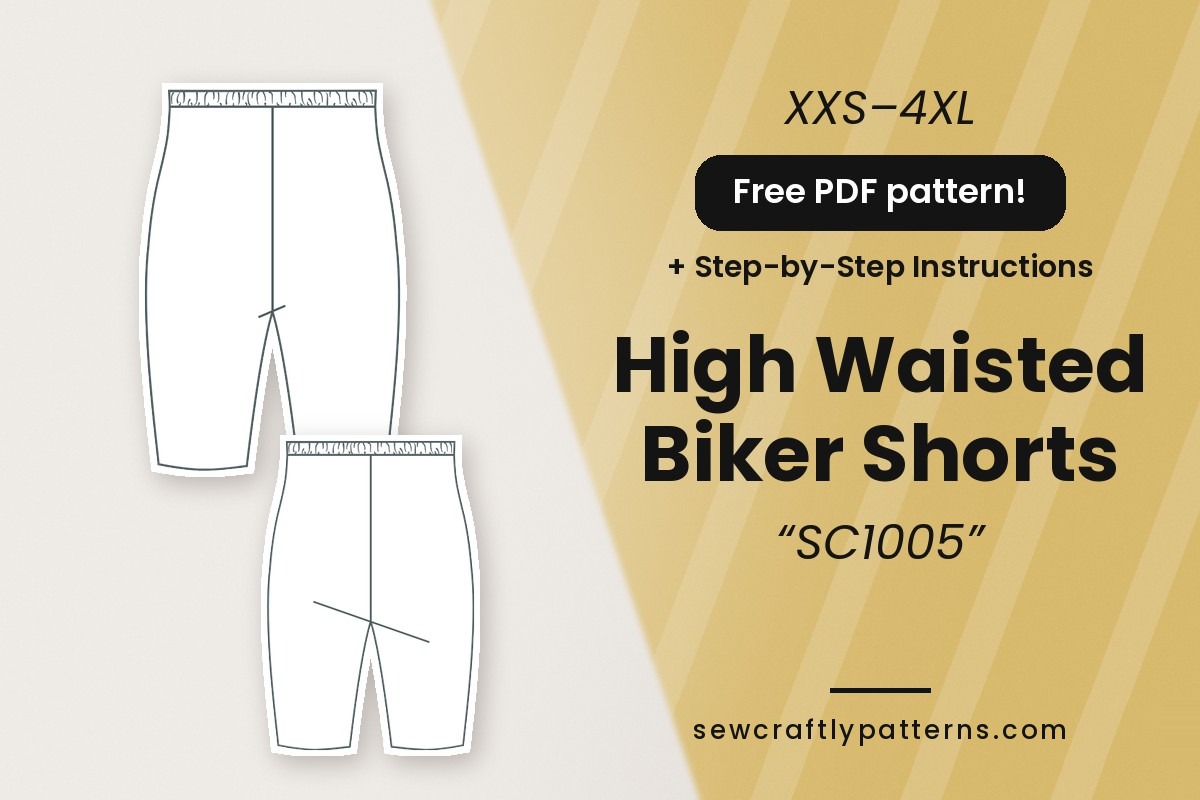
Garment Shorts
Level Easy
Sizes 00 – 22
Fabric 4-way stretch knit
Pieces 2
A snug, high-waisted biker short sewn from stretch knit, with a comfortable elastic waistband. Each leg is cut in one piece on the fold at the side, so all you sew is the crotch seam, the inseam and the waistband. A go-to layering piece for workouts or everyday wear.
Biker shorts are one of those pieces you reach for every week once you have a good pair, and this free biker shorts sewing pattern makes it easy to sew several. They sit high on the waist, hug the hips and thighs, and stop at mid-thigh, so they stay put under a dress, at the gym or on a long walk. The fit comes from four-way stretch fabric and negative ease rather than from shaping seams, which is why there are only two pattern pieces. That simplicity makes them a brilliant first knit project and a quick, satisfying sew for anyone who already has a few makes behind them. Sew them in a bold athletic lycra for workouts or a soft cotton jersey for lounging.
Materials
- Main fabric: 0.7 m (3/4 yd) four-way stretch knit: cotton/spandex jersey, ponte, or athletic/swim lycra
- Elastic: 3.3 cm (1 1/4″) wide, cut to length (see the table below)
- All-purpose thread, or stretch/wooly nylon thread
- A large safety pin, to thread the elastic
- Ballpoint or stretch machine needle
Based on 150–160 cm (59–63″) wide fabric. Sizes 20 and 22 need the full 155–160 cm width, or about double the yardage on a narrower bolt.
Pattern pieces
- Pants, main fabric: cut 2, each on the fold at the side seam
- Waistband, main fabric: cut 1
Lay the pieces with the grainline on the lengthwise grain and the greatest stretch running around the body. Cut the notches, then mark the waistband foldline, center front and center back.
New to PDF patterns? Start here
Our free step-by-step guides take you from your measurements to a printed pattern:
- How to take your body measurements: what to measure and how, in 10 minutes.
- How to choose your size: which measurement to follow, and what to do between sizes.
- How to print and assemble your pattern: A4, US Letter or A0, the test box, and taping the pages.
Get the pattern
PDF pattern in A4, US Letter and A0, with one file per size (00 to 22). Share your make with #sewcraftly!
Print page 1 at 100% and check that the calibration box measures 4 in (101.5 mm). New to PDF patterns? Read how to print and assemble a PDF pattern.
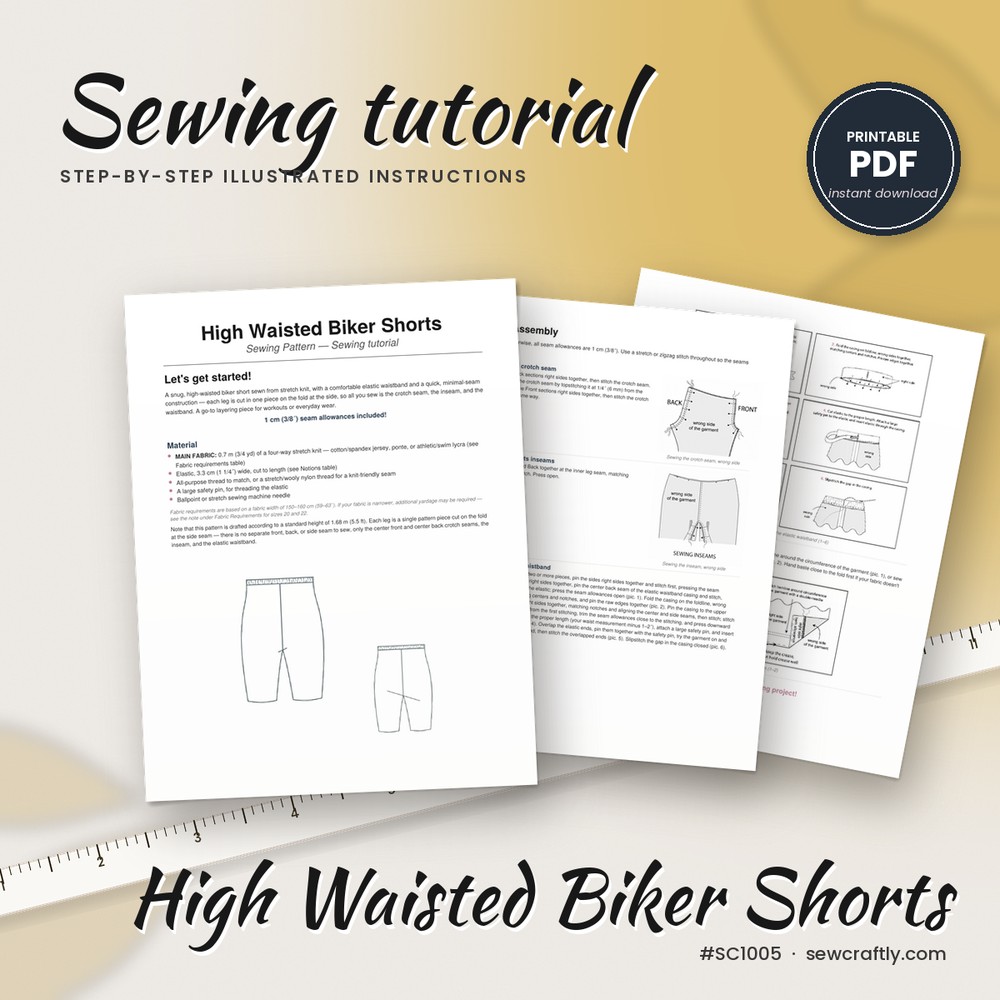
Printable sewing tutorial
Need help completing the project?
Get the full printable tutorial for this pair of biker shorts: detailed step-by-step sewing instructions with clear illustrations, line sketches, a sizing guide and the list of materials you need.
- Illustrated diagrams for every step
- Sizing guide and fabric table per size
- Printable PDF, instant download
Design and fit of these high waisted biker shorts
Each leg is a single piece cut on the fold at the side, so there is no outer side seam at all. That keeps the outside of the leg smooth and makes the shorts feel very comfortable against the skin. The side length is about 39–40 cm depending on size, which usually lands at mid-thigh.
The shorts are drafted with negative ease: the finished pattern is smaller than your body, and the fabric’s stretch does the fitting. A folded waistband with a 3.3 cm elastic inside sits high and flat on the waist without digging in. The result is a smooth, supportive fit that works under skirts and dresses as well as on its own.
Difficulty and sewing time
The pattern is rated easy, with five short steps. Most of the time goes into getting used to sewing knits if you haven’t before. Expect around 1–2 hours once the pattern is printed and cut, often less for a second pair.
You will need a ballpoint or stretch needle, a stretch or zigzag stitch (or an overlocker), a large safety pin for the elastic, clips or pins, and optionally a walking foot or twin needle for the hem.
Sizing guide
Drafted for a height of 1.68 m (5′6″). Choose your size by hip measurement: the stretch knit and elastic waistband give some ease at the waist and thigh. Not sure? Read how to choose your size.
Letter sizes: 00/0 = XXS · 2/4 = XS · 6/8 = S · 10/12 = M · 14 = L · 16 = XL · 18 = XXL · 20 = 3XL · 22 = 4XL
Body measurements
| cm | 00 | 0 | 2 | 4 | 6 | 8 | 10 | 12 | 14 | 16 | 18 | 20 | 22 |
|---|---|---|---|---|---|---|---|---|---|---|---|---|---|
| Bust | 80 | 82.5 | 85 | 87.75 | 90.25 | 92.75 | 95.25 | 99.25 | 104.25 | 109.25 | 114.25 | 119.25 | 124.25 |
| Waist | 63.5 | 66 | 68.75 | 71.25 | 73.75 | 76.25 | 78.75 | 82.75 | 87.5 | 93.25 | 99 | 104.75 | 110.5 |
| Hips | 87.75 | 90.25 | 92.75 | 95.25 | 98 | 100.25 | 102.75 | 106.5 | 111 | 115.5 | 120.75 | 125.75 | 130.75 |
Finished garment measurements
| cm | 00 | 0 | 2 | 4 | 6 | 8 | 10 | 12 | 14 | 16 | 18 | 20 | 22 |
|---|---|---|---|---|---|---|---|---|---|---|---|---|---|
| Low hips, half | 41.12 | 42.26 | 45.27 | 44.56 | 45.83 | 46.87 | 48.01 | 49.74 | 51.81 | 53.88 | 56.3 | 58.6 | 60.89 |
| Thigh, half | 53.22 | 54.72 | 58.63 | 57.69 | 59.06 | 60.19 | 61.44 | 63.31 | 65.56 | 67.81 | 70.43 | 72.92 | 75.41 |
| Leg opening, half | 38.11 | 39.14 | 41.65 | 40.81 | 41.83 | 42.77 | 43.94 | 45.5 | 47.18 | 48.85 | 50.82 | 52.74 | 54.84 |
| Side length | 39.16 | 39.22 | 39.24 | 39.37 | 39.42 | 39.48 | 39.51 | 39.58 | 39.68 | 39.78 | 39.84 | 39.93 | 40.01 |
Low hips, thigh and leg opening are half-widths measured flat on one leg piece: double them for the full circumference. The shorts are drafted with negative ease, so they measure smaller than the body.
Elastic length
| cm | 00 | 0 | 2 | 4 | 6 | 8 | 10 | 12 | 14 | 16 | 18 | 20 | 22 |
|---|---|---|---|---|---|---|---|---|---|---|---|---|---|
| Elastic | 53.2 | 55.2 | 57.4 | 59.4 | 61.4 | 63.4 | 65.4 | 68.6 | 72.4 | 77 | 81.6 | 86.2 | 90.8 |
About your waist measurement minus 1–2″. Try it around your waist before cutting.
Common fit adjustments
Leg length. To make them shorter or longer, change the length at the hem, keeping the leg opening the same width. A longer leg also needs a little extra fabric.
Rise. If the waistband sits too high or too low, raise or lower the top edge of the pattern evenly at front and back before cutting.
Hips. Size is chosen by hip, as explained in how to choose your sewing pattern size. If your fabric has less stretch than a typical lycra, consider going up a size.
Waist. The elastic controls the waist fit. Measure your waist, start from the elastic table and adjust until it feels snug but comfortable.
Sewing notes
Fit & style
Pick your size by hips. The finished shorts are smaller than your body: the fabric’s stretch and the elastic give the fit.
Fabrics
Use a knit with good four-way stretch and recovery. Avoid wovens and fabrics with little stretch.
Cutting & sewing
Pre-wash and press. Use a ballpoint needle, a walking foot if you have one, and a stretch or zigzag stitch.
Choosing fabric for biker shorts
Everything depends on stretch and recovery. Athletic or swim lycra is the classic choice: it stretches both ways, snaps back into shape and stays opaque. Cotton-spandex jersey is softer and more breathable for everyday wear. Ponte is thicker and very opaque, good for cooler days.
Avoid wovens and two-way stretch knits: the shorts are smaller than your body and need stretch in both directions to go on. Thin jerseys without spandex tend to bag at the knees and seat after a few wears. Before buying, stretch the fabric in your hands; if it goes see-through, it will be too thin for close-fitting shorts.
Pre-wash cotton jersey, which shrinks; lycra rarely needs it, but washing removes finishes that can cause skipped stitches. Nap is not usually an issue, but cut both legs in the same direction on prints and velvety fabrics. No interfacing is needed for this pattern.
Sewing steps
Seam allowances are 1 cm (3/8″) unless stated otherwise. Use a stretch or zigzag stitch throughout so the seams keep their give.
- Sew the crotch seams. Stitch the Back crotch seam, right sides together, and topstitch it 6 mm (1/4″) from the edge. Repeat for the Front.
- Sew the inseams. Pin Front and Back together at the inner leg, matching notches. Stitch and press open.
- Make and attach the waistband. Sew the casing into a loop, leaving a gap for the elastic. Fold it in half and stitch it to the top of the shorts.
- Insert the elastic. Thread the elastic through the casing, try the shorts on, stitch the ends together and close the gap.
- Hem the shorts. Turn up the hem and sew it with a zigzag stitch or a double needle. Press.
Tips for sewing stretch shorts
Test your stitch on a scrap. Stretch the seam hard after sewing. If threads pop, widen the zigzag or switch to a stretch stitch.
Don’t stretch while you sew. Let the machine feed the fabric. Pulling the knit gives wavy seams, especially along the crotch curve.
Match the crotch seams exactly. At the inseam, line up the front and back crotch seams before stitching; a misaligned join shows clearly in tight-fitting shorts.
Try on before closing the elastic. Pin the elastic ends together and wear the shorts for a minute. Adjust until the waistband feels secure without pressing.
Keep the hem stretchy. A straight stitch at the leg opening will snap. Use a zigzag or a twin needle, as step 5 says.
Variations to try
Longer cycling length. Extend the leg toward the knee for a sportier short.
Contrast waistband. Cut the waistband in a different colour of the same fabric for a sporty look.
Under-dress shorts. Shorten the legs and make them in a soft, skin-tone jersey to wear under skirts and dresses on hot days.
How to style them
Workout: lycra shorts with a sports bra and trainers.
Casual: black biker shorts with an oversized shirt or sweatshirt and sneakers.
Layered: under a dress, or with a fitted jacket such as the Elodie jacket for an athleisure look. For a summer outfit, sew a spaghetti strap dress to go with them.
Questions
What is in the paid guide?
The same steps as above, explained in more detail with a diagram for every action, plus the full sizing and fabric tables in one printable PDF. The pattern itself stays free.
Is seam allowance included?
Yes, 1 cm (3/8″) on every edge.
Can I use a woven fabric?
No. The pattern relies on four-way stretch to fit, so a woven won’t go over your hips.
How long should the elastic be?
Use the elastic table above, then try it around your waist. It should be snug but comfortable.
Can I sew biker shorts without an overlocker?
Yes. A regular sewing machine with a narrow zigzag or stretch stitch and a ballpoint needle is enough. An overlocker is faster but not required.
What is the best fabric for biker shorts?
A four-way stretch knit with good recovery: athletic or swim lycra for sport, cotton-spandex jersey for everyday comfort, or ponte for a thicker, more opaque short.
Why are the shorts smaller than my measurements?
They are drafted with negative ease, which is normal for close-fitting activewear. The fabric stretches around your body to give a smooth, supportive fit.
Is this a good first knit project?
Yes. With two pieces and five steps, it is one of the simplest ways to practise sewing stretch fabric. Start with a stable cotton-spandex jersey before moving to slippery lycra.
How do I stop the waistband from rolling?
Use firm elastic in the width given in the materials list, and cut it to the length in the table. A fabric with good recovery and a snug elastic keep the waistband flat.
How long does it take to sew?
Around 1–2 hours after cutting. Once you have made one pair, the next ones go much faster.
Happy sewing!
Love our free patterns? Buy us a coffee to keep them coming, or simply share, pin and comment. Thank you!
 Support me on Ko-fi
Keep sewing
Thank you