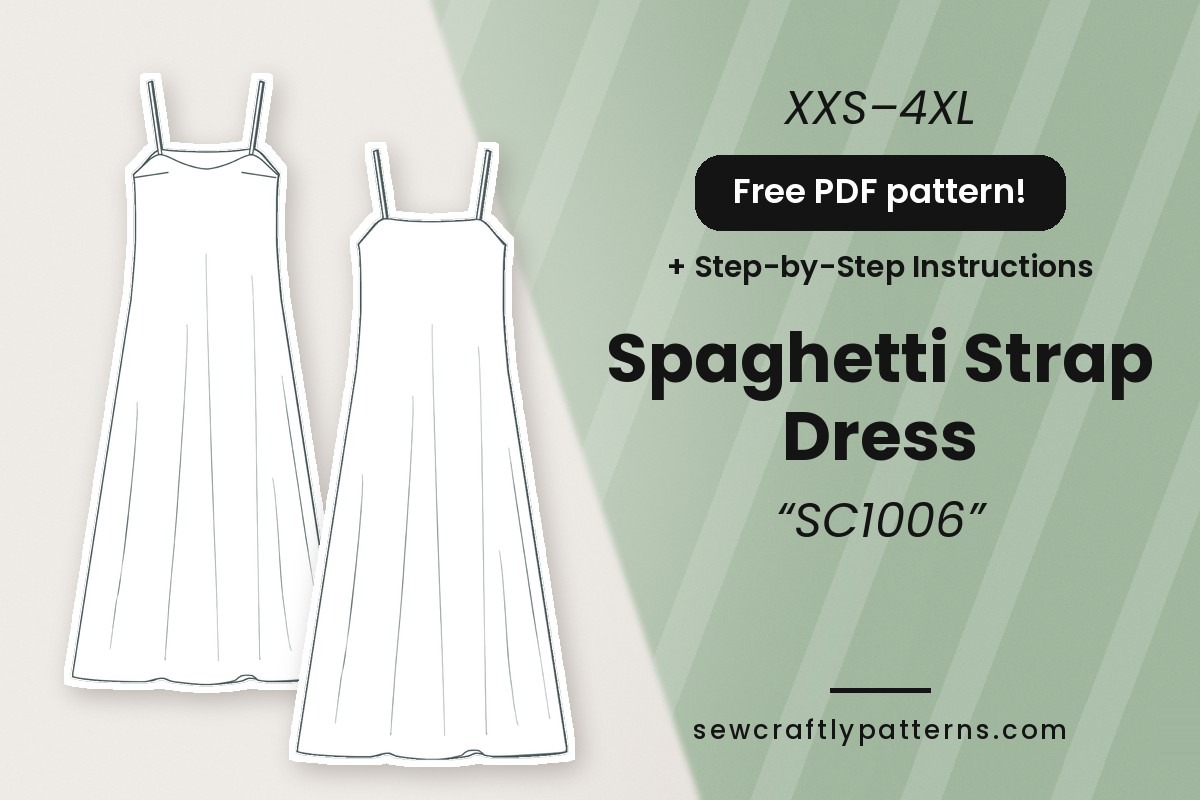
Garment Maxi dress
Level Intermediate
Sizes XXS – 4XL
Fabric Linen / cotton
Pieces 7
A long, easy-to-wear slip dress with narrow straps, a softly curved neckline and a skirt that flares gently to the ankle. The bodice is fully lined with neat facings, so the inside is as clean as the outside, and front bust darts give it shape without any zip or waist seam. It looks lovely in a soft floral linen or cotton for summer, and just as good in a plain viscose for evenings out.
Some dresses ask for an occasion; this free spaghetti strap dress sewing pattern simply asks for a warm day. It is a long, column-like slip that skims the bust, falls past the waist without a seam to interrupt it, and opens into a soft flare around the ankles. Because the whole thing hangs from two narrow straps, it moves beautifully when you walk and feels almost weightless to wear. It is a natural summer staple: beach holidays, garden lunches, warm city evenings. The clean neckline suits anyone who likes to show their shoulders, and the gentle A-line skirt is relaxed enough to be comfortable whether your shape is straight, curvy or somewhere in between.
Materials
- Main fabric: 1.8 to 2.2 m (2 to 2 3/8 yd) lightweight woven: linen or cotton-linen blend, cotton lawn or poplin, or viscose/rayon challis. Floral prints work beautifully
- Lining: 1.5 to 1.8 m (1 5/8 to 2 yd): cotton voile, batiste or a rayon/Bemberg lining
- Fusible interfacing: lightweight, for the facings and straps
- Matching all-purpose thread
- Hand-sewing needle, pins or clips, marking tool
Estimates for 140–150 cm (55–60″) wide fabric; see the full table per size below. Allow extra for prints that need matching or fabrics with a nap.
Pattern pieces
- Front, main fabric: cut 1 on the fold
- Back, main fabric: cut 1 on the fold
- Front lining, lining: cut 1 on the fold
- Back lining, lining: cut 1 on the fold
- Front facing, main fabric + interfacing: cut 1 + 1
- Back facing, main fabric + interfacing: cut 1 + 1
- Strap, main fabric + interfacing: cut 2
Follow the grainline and FOLD markings. Transfer the bust darts and all notches before you remove the paper.
New to PDF patterns? Start here
Our free step-by-step guides take you from your measurements to a printed pattern:
- How to take your body measurements: what to measure and how, in 10 minutes.
- How to choose your size: which measurement to follow, and what to do between sizes.
- How to print and assemble your pattern: A4, US Letter or A0, the test box, and taping the pages.
Get the pattern
PDF pattern in A4, US Letter and A0, with one file per size (00 to 22). Share your make with #sewcraftly!
Print page 1 at 100% and check that the calibration box measures 4 in (101.5 mm). New to PDF patterns? Read how to print and assemble a PDF pattern.
Printable sewing tutorial
Need help completing the project?
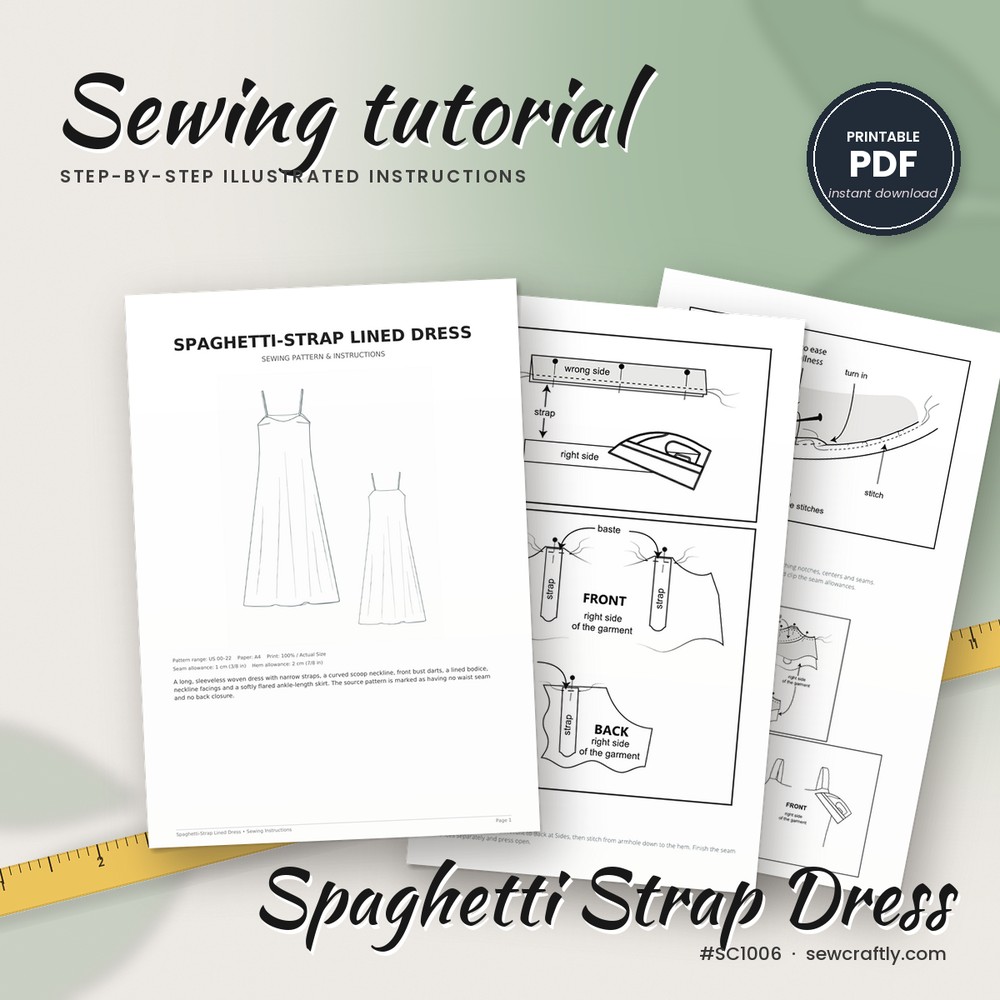
Get the full printable tutorial for this dress: detailed step-by-step sewing instructions with clear illustrations, line sketches, a sizing guide and the list of materials you need.
- Illustrated diagrams for every step
- Sizing guide and fabric table per size
- Printable PDF, instant download
Design details of this slip maxi dress
The dress is shaped by front bust darts only. There is no waist seam and no zip, so it pulls on over the head and relies on the gentle flare of the side seams to fall smoothly over the hips. Measured from the neckline, it reaches roughly 122 cm at the centre front and a little more at the back, which lands at the ankle on a 1.68 m figure.
Inside, the dress is lined, with a facing of main fabric at the top of the lining so the lining never peeks out at the neckline. The straps are interfaced, which keeps them from stretching under the weight of a long skirt. The result is a dress that looks simple from the outside but is neatly finished all the way through.
Difficulty and sewing time
It is rated intermediate. None of the steps are complicated, but joining the lining at the neckline and armholes and turning it out cleanly takes care, and a long curved hem in a light fabric needs patience. Plan on about 5–7 hours, plus time for printing and cutting a long pattern.
You will need a sewing machine, a loop turner or safety pin for the straps, a fine universal or microtex needle, pins or clips, a marking tool, and a large, clear space for cutting the skirt pieces on the fold.
Sizing guide
Drafted for a height of 1.68 m (5′6″). Choose your size by bust measurement: the bodice is fitted with darts, while the skirt flares out and leaves plenty of room at the waist and hips. Between two sizes? Go with the larger one. Not sure? Read how to choose your size.
Letter sizes: 00/0 = XXS · 2/4 = XS · 6/8 = S · 10/12 = M · 14 = L · 16 = XL · 18 = XXL · 20 = 3XL · 22 = 4XL
Body measurements
| cm | 00 | 0 | 2 | 4 | 6 | 8 | 10 | 12 | 14 | 16 | 18 | 20 | 22 |
|---|---|---|---|---|---|---|---|---|---|---|---|---|---|
| Bust | 80 | 82.5 | 85 | 87.75 | 90.25 | 92.75 | 95.25 | 99.25 | 104.25 | 109.25 | 114.25 | 119.25 | 124.25 |
| Waist | 63.5 | 66 | 68.75 | 71.25 | 73.75 | 76.25 | 78.75 | 82.75 | 87.5 | 93.25 | 99 | 104.75 | 110.5 |
| Hips | 87.75 | 90.25 | 92.75 | 95.25 | 98 | 100.25 | 102.75 | 106.5 | 111 | 115.5 | 120.75 | 125.75 | 130.75 |
Finished garment measurements
| cm | 00 | 0 | 2 | 4 | 6 | 8 | 10 | 12 | 14 | 16 | 18 | 20 | 22 |
|---|---|---|---|---|---|---|---|---|---|---|---|---|---|
| Center front to hem | 122.44 | 122.09 | 122.06 | 122.06 | 121.85 | 121.93 | 121.66 | 122.6 | 122.72 | 122.52 | 122.59 | 122.71 | 122.94 |
| Center back to hem | 127.01 | 126.44 | 125.94 | 125.61 | 125.1 | 124.69 | 124.34 | 125.17 | 125.14 | 125.21 | 125.44 | 125.47 | 125.95 |
| Hem sweep | 108.92 | 109.85 | 111.05 | 112.49 | 114.07 | 116.03 | 117.71 | 120.31 | 122.33 | 125.34 | 128.16 | 131.44 | 134.23 |
| Strap length | 23.03 | 23.94 | 25.17 | 25.95 | 26.85 | 27.76 | 28.49 | 29.09 | 29.69 | 29.94 | 30.24 | 31.01 | 31.06 |
Lengths are measured from the neckline to the hem on the pattern. If you are shorter or taller than 1.68 m, check the length against a long dress you own and adjust at the hem.
Fabric requirements
| cm | 00 | 0 | 2 | 4 | 6 | 8 | 10 | 12 | 14 | 16 | 18 | 20 | 22 |
|---|---|---|---|---|---|---|---|---|---|---|---|---|---|
| Main fabric | 180 | 180 | 180 | 190 | 190 | 190 | 200 | 200 | 200 | 210 | 210 | 210 | 220 |
| Lining | 150 | 150 | 150 | 160 | 160 | 160 | 170 | 170 | 170 | 170 | 170 | 170 | 180 |
Estimates for 140–150 cm (55–60″) wide fabric. Check your cutting layout before buying.
Common fit adjustments
Strap length. Straps are the easiest place to fine-tune a slip dress. Baste them first, try the dress on, and move the neckline up or down by shortening or lengthening the straps before you join the lining.
Shoulders and strap position. If the straps slide off, move their placement a little closer to the neck on both the front and back. Keep the change the same on both sides so the neckline stays balanced.
Bust. Choose your size by bust, as shown in how to choose your sewing pattern size. If the neckline gapes or pulls, the bust dart can be lengthened, shortened or made deeper; make the same change on the lining.
Waist and hips. With no closure, the dress must pass over your shoulders and hips. Compare your body measurements with the pattern and, if you need more room at the hip, add a little at the side seams and blend back to the bust.
Sewing notes
Fit & style
Pick your size by bust. There is no zip, so the dress slips over the head: make sure the finished hip width is comfortable before you sew the side seams.
Fabrics
Choose a light woven: linen, cotton-linen, cotton lawn or viscose. A soft floral print suits the long, flared skirt. Avoid stiff fabrics, which make the skirt stand away from the body.
Cutting & sewing
Pre-wash and press both fabrics. Staystitch the necklines right after cutting, and press every seam as you go.
Choosing fabric for a slip dress
A long slip dress lives or dies by its drape. Viscose or rayon challis gives the most fluid, liquid fall and is lovely for evening. Linen and cotton-linen hang with more body and texture and soften with every wash. Cotton lawn and poplin are crisp, breathable and easy to handle, a good choice for a first version.
Avoid heavy or stiff fabrics such as denim, canvas or thick cotton twill: the skirt will stand away from the body and the narrow straps will struggle with the weight. Sheer fabrics are fine on the outside because the dress is lined.
Pre-wash both the main fabric and the lining, since linen, cotton and viscose can all shrink, and a lining that shrinks differently will twist the hem. For the lining itself, cotton voile or batiste feels cool on the skin, while a rayon or Bemberg lining slides more easily over the body.
Large one-way florals and border prints need every piece cut in the same direction, so allow extra fabric. Use the lightest fusible interfacing you can find for the facings and straps; anything heavier makes the top edge stiff.
Sewing steps
Seam allowances are 1 cm (3/8″) and the hem allowance is 2 cm (7/8″). Sew with right sides together unless a step says otherwise.
- Sew the bust darts. Stitch the darts on the Front from the side seam toward the point, knot the thread tails and press the darts down. Staystitch the Front neckline.
- Make the straps. Interface the straps, fold them in half lengthwise, stitch, turn them right side out and press.
- Attach the straps. Baste the straps to the right side of the Front and Back at the notches, raw edges even.
- Sew the side seams. Pin Front to Back and stitch from the armhole to the hem. Finish the edges and press open.
- Prepare the lining. Sew the darts on the Front lining and staystitch its neckline. Fuse the facings, then sew the Front facing to the Front lining and the Back facing to the Back lining. Press toward the lining.
- Sew the lining side seams. Stitch the lining side seams from armhole to hem, finish and press open.
- Join lining and dress. Pin them right sides together at the neckline and armholes, matching seams and notches. Stitch, trim, clip the curves, understitch, then turn the lining inside and press.
- Hem the lining. Turn up a narrow double hem, easing in any fullness, and stitch.
- Hem the dress. Press up a narrow double hem along the curved lower edge, ease in the fullness and stitch.
- Final press. Press the neckline, armholes, straps and hem from the right side, and check that the lining lies smooth inside.
Tips for a clean finish
Staystitch straight after cutting. The curved neckline and armholes of a slip dress stretch very easily, especially in viscose. Staystitch them before the pieces are handled much.
Understitch the lining. Understitching at step 7 is what keeps the lining rolled to the inside. Stitch as far into the strap area as you can reach.
Let the dress hang before hemming. Flared skirts in light fabrics drop unevenly along the curved hem. Hang the dress overnight, then level the hem on yourself or a dress form before you stitch it.
Hem the lining a little shorter. A lining that ends a few centimetres above the dress hem never shows when you walk or sit.
Use a fresh, fine needle. Viscose and lawn snag on blunt needles. A new microtex or 70/10 needle and a slightly shorter stitch give much neater seams.
Variations to try
Midi slip dress. Shorten the front, back and lining by the same amount for a mid-calf length, as explained in the questions below.
Tie straps. Cut the straps longer, stitch only the front ends into the dress and tie them in bows at the back for adjustable straps.
Side slit. Leave the lower part of one side seam open and finish the edges for a slit that makes walking easier in a narrower fabric.
How to style it
Beach day: a floral cotton version with flat sandals, a straw bag and a wide hat.
City evening: plain viscose with heeled sandals and a fitted layer on top, such as the Elodie fitted jacket worn open.
Cooler days: over a thin tee or under a cropped jacket like the puff sleeve peplum jacket, with ankle boots.
Questions
What is in the paid guide?
The same steps as above, explained in more detail with a diagram for every action, plus the full sizing, fabric and cutting tables in one printable PDF. The pattern itself stays free.
Is seam allowance included?
Yes: 1 cm (3/8″) on every seam and 2 cm (7/8″) at the hem.
Does the dress need a zip?
No. There is no zip and no back closure: the dress slips on over the head. Check the finished measurements for your size before you sew.
Can I make it shorter?
Yes. Shorten the Front, Back and both lining pieces by the same amount along the hem, keeping the flare of the side seams.
Can I use a stretch fabric?
The pattern is drafted for wovens. A stable knit can work, but the fit will be looser and you can skip the lining.
Is this maxi dress pattern good for beginners?
It is rated intermediate, but an adventurous beginner can manage it. Start with a stable cotton rather than viscose, and take your time with the lining at the neckline and armholes.
What is the best fabric for a spaghetti strap dress?
Light wovens with good drape: viscose challis for a fluid look, linen or cotton-linen for texture, or cotton lawn for an easy first make. Avoid heavy, stiff fabrics.
Can I skip the lining?
The pattern is designed with a lining and facings. Leaving it out is a self-drafted change: you would need to finish the neckline and armholes another way, for example with bias binding.
Can I wear a regular bra with it?
Narrow straps and a low back will show most bra straps. A strapless or low-back bra works best, or you can sew in bra cups between the dress and the lining.
How do I stop the hem from looking uneven?
Let the finished dress hang for a day before hemming so the fabric can drop, then mark the hem at an even height from the floor and trim before turning it up.
How long does it take to sew?
Around 5–7 hours for most sewists, not counting printing and cutting. Slippery fabrics like viscose usually take longer.
Happy sewing!
Love our free patterns? Buy us a coffee to keep them coming, or simply share, pin and comment. Thank you!
 Support me on Ko-fi
Keep sewing