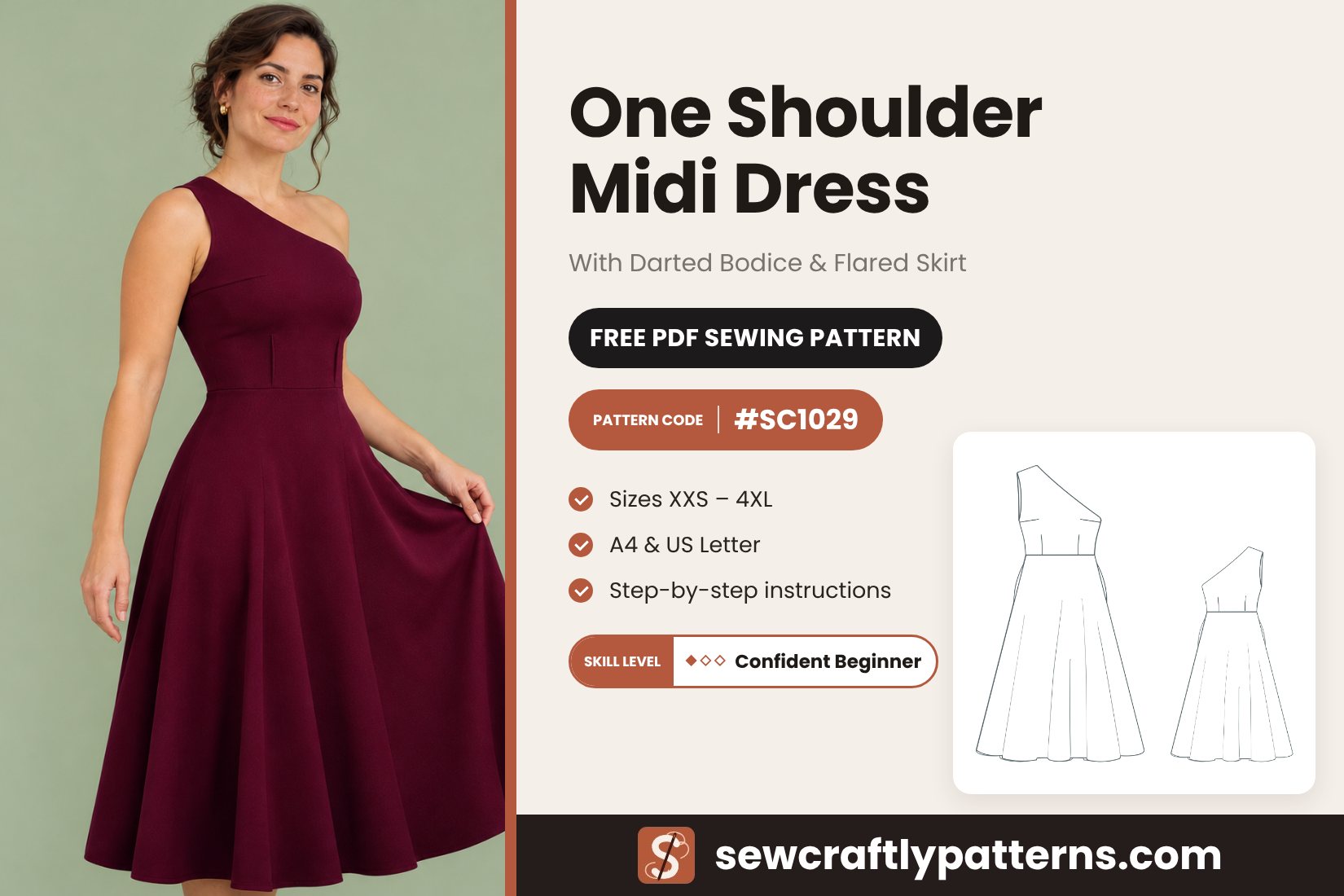
Garment One shoulder midi dress
Level Confident beginner
Sizes XXS – 4XL
Fabric Light to medium-weight wovens
Pieces 7
This free one shoulder dress sewing pattern makes an elegant midi dress for summer weddings, garden parties and warm evenings. A clean asymmetric bodice, shaped with darts, meets a full, swingy skirt at the natural waist and falls to mid-calf.
The pattern is drafted for light to medium-weight woven fabrics with some drape: cotton sateen, crepe, viscose, a linen-viscose blend or a light cotton twill. The bodice has two bust darts and two waist darts at the front and two waist darts at the back, so it sits close without any stretch. A hidden pocket sits in the right side seam, and an invisible zip in the left side seam keeps the front line clean. The neckline is finished with bias tape turned to the inside and the armhole with an interfaced facing, so there is no lining to sew. In our photos we made it in a deep burgundy crepe.
Materials
- Main fabric: 2.2 to 2.6 m (2 1/2 to 2 7/8 yd) of 150 cm wide fabric, or 2.6 to 3.4 m (2 7/8 to 3 3/4 yd) of 115 cm wide, depending on your size: crepe, cotton sateen, viscose, linen-viscose, light cotton twill or poplin
- Pocket lining: 0.3 m (3/8 yd) of lining or cotton
- Light fusible interfacing: 0.3 m (3/8 yd), 90 cm wide, for the armhole facings
- One invisible zip, 32 to 38 cm (12 5/8 to 15″) depending on your size
- Single-fold bias tape 25 mm (1″), 79 to 109 cm long, or a self-fabric bias strip 5 cm (2″) wide
- Matching thread, an invisible zip foot, chalk or a washable marker
Pattern pieces
- 1 Front, main fabric: cut 1, single layer, right side up
- 2 Skirt front, main fabric: cut 1, whole piece
- 3 Back, main fabric: cut 1, single layer, right side up
- 4 Skirt back, main fabric: cut 1, whole piece
- 5 Front armhole facing, main fabric and interfacing: cut 1 + 1
- 6 Back armhole facing, main fabric and interfacing: cut 1 + 1
- 7 Pocket bag, lining: cut 2 for the right-side pocket
Every piece is drawn whole: cut on a single layer, right side up, with the printed side of the pattern up, never on the fold. The bodice is asymmetric, so a piece cut upside down puts the shoulder on the wrong side. On the skirt pieces the grainline runs across the piece: follow the arrow exactly as printed.
New to PDF patterns? Start here
Our free step-by-step guides take you from your measurements to a printed pattern:
- How to take your body measurements: what to measure and how, in 10 minutes.
- How to choose your size: which measurement to follow, and what to do between sizes.
- How to print and assemble your pattern: A4 or US Letter, the test box, and taping the pages.
Get the pattern
Free PDF pattern, with one file per size, XXS to 4XL (US 00–22). Share your make with #sewcraftly!
Print page 1 at 100% and check that the test square measures 10 cm (4 in). New to PDF patterns? Read how to print and assemble a PDF pattern.
Printable sewing tutorial
Need help completing the project?
Get the full printable tutorial for the One Shoulder Midi Dress: detailed step-by-step sewing instructions with clear illustrations, line sketches, a sizing guide and the list of materials you need.
- Illustrated diagrams for every step, from the bodice darts to the invisible zip and bias-finished neckline
- Size charts, finished measurements and fabric amounts per size
- Video guides for the key techniques, with links and QR codes
- Printable PDF, instant download
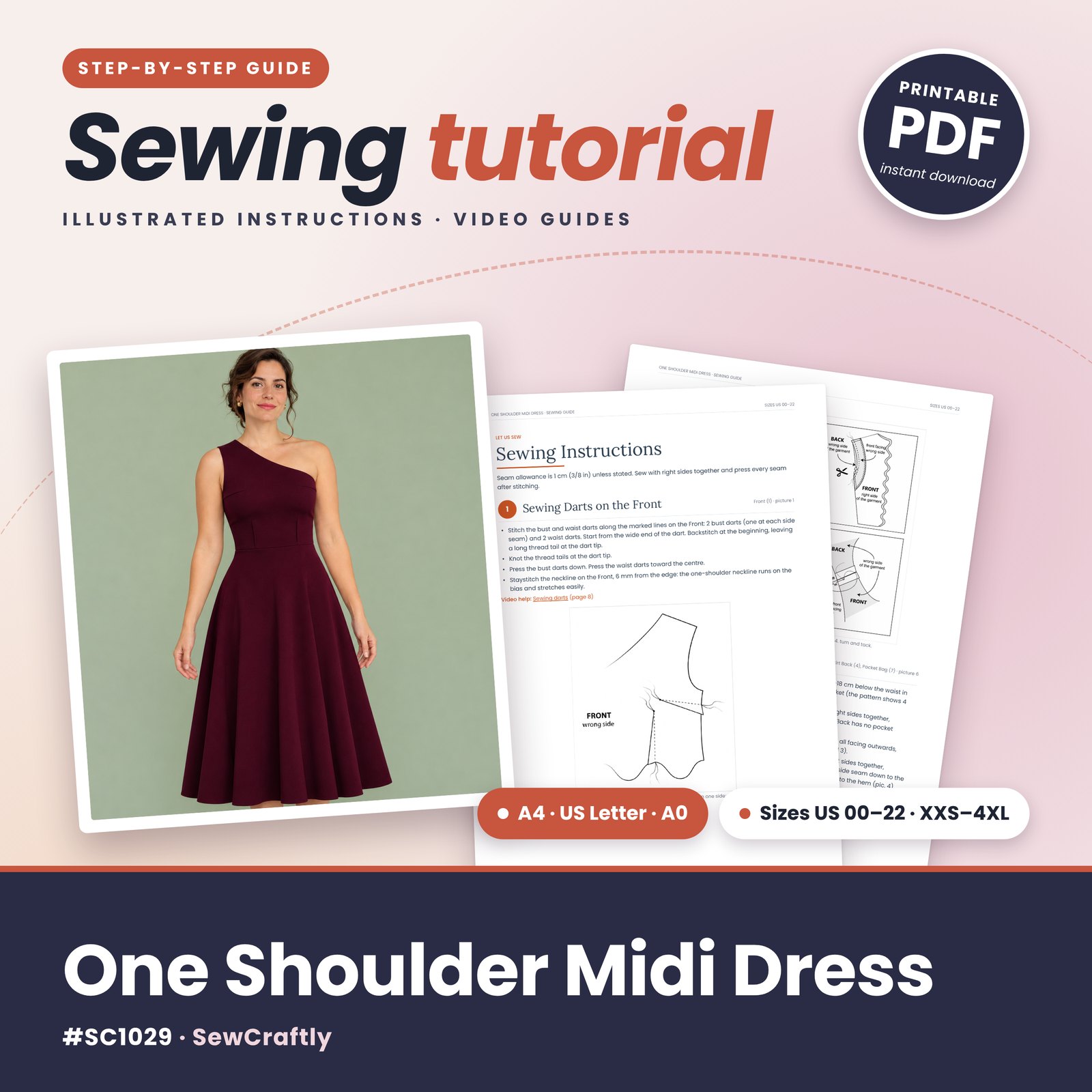
Design details and fit of the one shoulder dress
- Asymmetric one-shoulder neckline, finished with bias tape turned to the inside
- Fitted bodice: 2 bust darts and 2 waist darts at the front, 2 waist darts at the back
- Armhole finished with an interfaced facing
- Full flared skirt cut in two pieces, joined at the natural waist
- In-seam pocket in the right side seam
- Invisible zip in the left side seam
- Midi length, about 116 cm (45 3/4″) from the shoulder in size 8
The pattern is drafted for a height of 168 cm (5′6″). The bodice is close-fitting, with about 5–6 cm (2–2 1/4″) of ease at the bust, while the skirt is very full: the hem measures almost 3 m around in size 8, so the dress swings beautifully when you move and the hips never need to match your size.
Sizing guide
Choose your size by your bust and waist measurements in the table below. The skirt is full, so you can ignore the hip measurement. Between two sizes, take the larger one at the bust. Not sure? Read how to choose your size.
Letter sizes: 00 = XXS · 0/2 = XS · 4/6 = S · 8/10 = M · 12/14 = L · 16 = XL · 18 = 2XL · 20 = 3XL · 22 = 4XL
Body measurements
| cm | 00 | 0 | 2 | 4 | 6 | 8 | 10 | 12 | 14 | 16 | 18 | 20 | 22 |
|---|---|---|---|---|---|---|---|---|---|---|---|---|---|
| Bust | 80 | 82.5 | 85 | 87.8 | 90.2 | 92.8 | 95.2 | 99.2 | 104.2 | 109.2 | 114.2 | 119.2 | 124.2 |
| Waist | 63.5 | 66 | 68.8 | 71.2 | 73.8 | 76.2 | 78.8 | 82.8 | 87.5 | 93.2 | 99 | 104.8 | 110.5 |
| Hips | 87.8 | 90.2 | 92.8 | 95.2 | 98 | 100.2 | 102.8 | 106.5 | 111 | 115.5 | 120.8 | 125.8 | 130.8 |
Finished garment measurements
| cm | 00 | 0 | 2 | 4 | 6 | 8 | 10 | 12 | 14 | 16 | 18 | 20 | 22 |
|---|---|---|---|---|---|---|---|---|---|---|---|---|---|
| Bust | 86 | 88 | 90 | 93 | 96 | 98 | 101 | 105 | 110 | 115 | 121 | 126 | 131 |
| Length | 116 | 116 | 116 | 116 | 116 | 117 | 117 | 117 | 118 | 119 | 119 | 120 | 121 |
| Skirt | 73 | 73 | 73 | 73 | 73 | 73 | 72 | 73 | 73 | 72 | 72 | 72 | 72 |
| Hem width | 289 | 291 | 294 | 296 | 298 | 300 | 302 | 307 | 318 | 323 | 329 | 334 | 340 |
Length is measured at the front, from the shoulder point at the neck to the hem. Skirt = waist seam to hem at the centre. Hem width is the full circumference. Seam allowances excluded.
Fabric and notions
| cm | US 00–6 | US 8–14 | US 16–22 |
|---|---|---|---|
| Main fabric, 150 cm wide | 220 | 230 | 260 |
| Main fabric, 115 cm wide | 260 | 310 | 340 |
| Pocket lining | 30 | 30 | 30 |
| Fusible interfacing, 90 cm wide | 30 | 30 | 30 |
Fabric amounts were calculated by laying out every piece of the largest size in each group on a single layer, plus about 8 % for shrinkage and straightening. The bias strip for the neckline can be cut from the leftovers between the skirt pieces. Add extra for prints that need matching.
Common fit adjustments
Length. Lengthen or shorten the bodice evenly at the waist seam line, and the skirt evenly along the hem curve, keeping its shape.
Bust and waist. Choose by the bust, then take in or let out the side seams at the waist when you try on the bodice before setting the zip.
Sewing notes
Fit & style
Close-fitting bodice, full skirt from the natural waist. Baste the side seam and try it on before the zip goes in.
Fabrics
Light to medium-weight wovens with drape: crepe, cotton sateen, viscose, linen-viscose, light twill. No stretch knits and nothing very stiff.
Cutting & sewing
Cut single layer, right side up. Staystitch the bias neckline right after the darts and handle it as little as possible.
Choosing fabric for a one shoulder dress
Crepe is the most forgiving choice: it presses well for the darts, drapes softly through the flared skirt and hides small imperfections, which is why we used it for the burgundy version in our photos. Cotton sateen gives a slightly crisper skirt with a soft sheen, perfect for a summer wedding, while viscose or a linen-viscose blend makes a cool, airy dress for hot days.
Avoid stretch knits, because the pattern is drafted for non-stretch wovens, and very stiff fabrics that make the full skirt stand out. Large one-way prints need care, since the skirt pieces are cut with the grainline across the piece: lay out all the pieces before cutting.
Sewing steps
Seam allowance 1 cm (3/8″) unless stated otherwise. Sew with right sides together and press each seam as you go.
- Front darts. Stitch the two bust darts and two waist darts on the front from the wide end to the point and knot the thread tails. Press the bust darts down and the waist darts toward the centre, then staystitch the neckline 6 mm from the edge.
- Back darts. Stitch the two waist darts on the back, press them toward the centre and staystitch the back neckline.
- Shoulder. Join the front and back at the shoulder, finish the allowances separately and press open.
- Right side seam. Stitch the side seam under the shoulder, matching the underarm points. Leave the left side open for the zip and finish its allowances now.
- Armhole facing. Fuse the interfacing, join the facing pieces, sew the facing to the armhole, clip and understitch, then turn it inside and tack it at the seams.
- Pocket and skirt seams. Sew a pocket bag to the skirt front and the skirt back on the right side, understitch, then stitch the right side seam around the pocket. On the left side, stitch from the hem up to the zip mark.
- Hem. Let the skirt hang for 24 hours if you can, then ease in the fullness with a basting thread, turn up the 2 cm hem and stitch.
- Skirt to bodice. Pin the skirt to the bodice, matching the darts, centres and right side seam, stitch, then stitch again inside the allowance and overlock. The left side stays open.
- Invisible zip. With an invisible zip foot, sew the zip to the front and then the back opening edges, keeping the waist seams level, and close the side seam below it.
- Neckline. Sew the bias tape along the neckline from zip edge to zip edge, fold the tails over the zip tape, understitch, turn the tape fully inside and edgestitch.
- Finishing. Knot and trim every thread tail and give the dress a final press on the wrong side with a press cloth.
Tips and common mistakes
Shoulder on the wrong side? Always cut the bodice pieces on a single layer, fabric right side up and pattern printed side up. Folding the fabric or flipping a piece mirrors the asymmetric neckline.
Gaping neckline. The one-shoulder edge runs on the bias: staystitch it as soon as the darts are done and never pull the bias tape tight while you sew it.
Zip across the waist seam. Baste the side seam first and check that the waist seams line up on both sides of the zip before you stitch it for good.
Uneven hem. A full flared skirt drops where it is cut off-grain. Letting it hang for a day before hemming gives a level hem.
How to style the one shoulder dress
Weddings and parties: strappy sandals, a small clutch and gold earrings that keep the shoulder line clean.
Day to evening: a fine belt at the waist seam and a cropped cardigan or denim jacket for cooler nights.
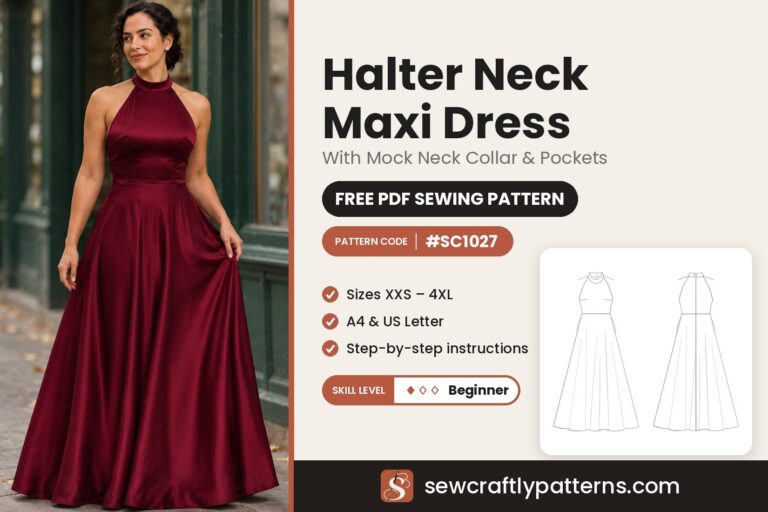
More dresses to sew: for another fitted bodice with a flared skirt, try our spaghetti strap dress sewing pattern, or the halter neck maxi dress sewing pattern for a full-length look.
Care
Wash as your fabric requires, and pre-wash it the same way before cutting. Close the zip before washing and iron on the wrong side.
Questions
Is seam allowance included?
Yes: 1 cm (3/8″) on all seams and a 2 cm (3/4″) hem allowance on the skirt.
Which paper sizes are included?
The free download comes in A4 and US Letter, as a printable PDF with one file per size, XXS to 4XL (US 00–22).
Which size should I choose?
Choose by your bust and waist measurements. The skirt is full, so the hips do not need to match. Between two sizes, take the larger one at the bust.
Can I sew it in a stretch knit?
No, the pattern is drafted for non-stretch woven fabric. A knit would make the bodice too loose and the neckline would stretch out.
How much fabric do I need?
From 2.2 m (sizes 00–6) to 2.6 m (sizes 16–22) of 150 cm wide fabric, plus 0.3 m of lining for the pocket bags. See the fabric table above.
Can I add a pocket on the left side?
The invisible zip runs about 16–18 cm below the waist through the pocket area on the left, so the pattern has a single pocket on the right side.
Is this one shoulder dress good for beginners?
It suits a confident beginner: darts, a facing, an in-seam pocket and an invisible zip. Take your time on the zip across the waist seam and the bias neckline.
Happy sewing!
Love our free patterns? Buy us a coffee to keep them coming, or simply share, pin and comment. Thank you!
 Support me on Ko-fi