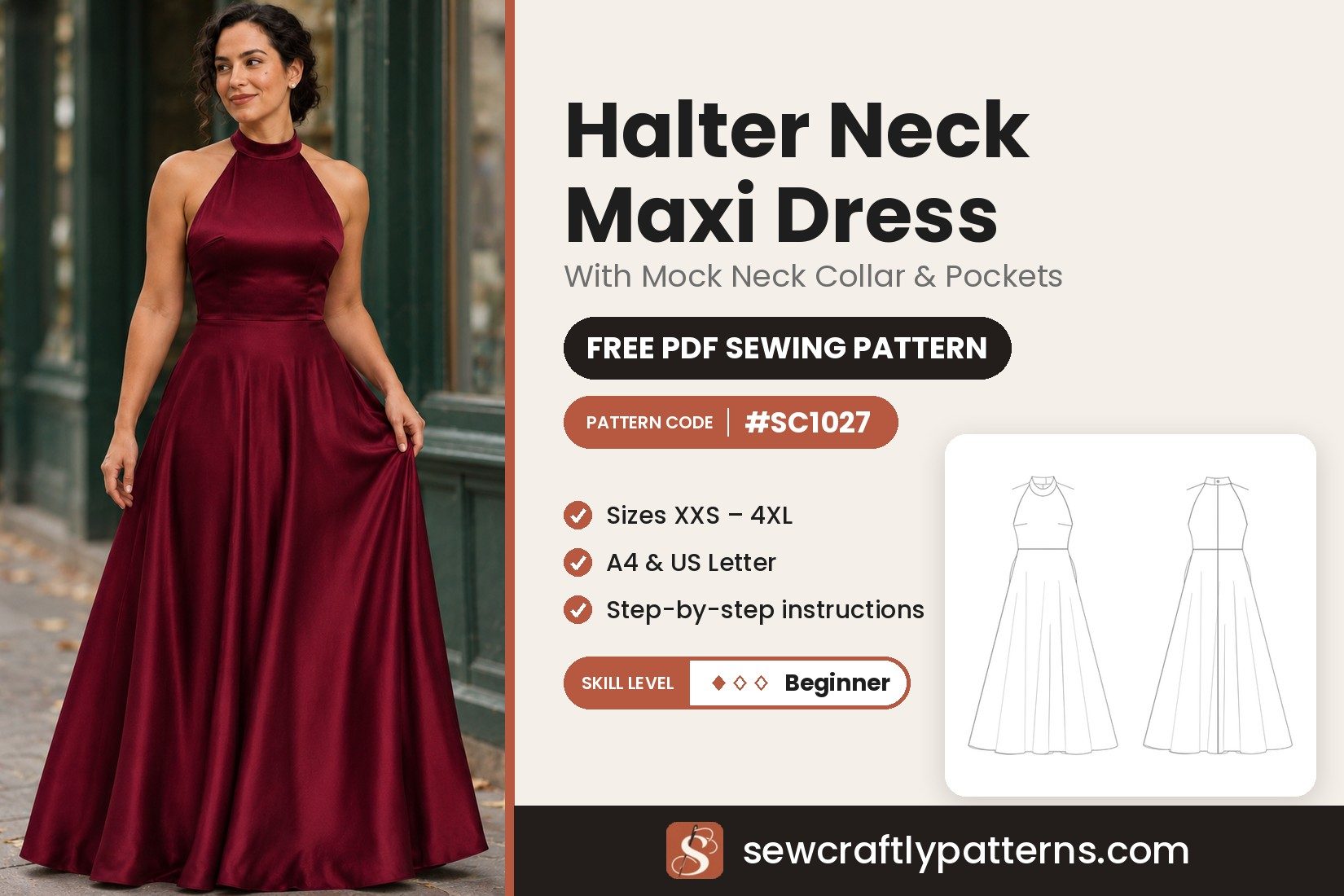
Garment Halter mock neck maxi dress
Level Easy · confident beginner
Sizes XXS – 4XL
Fabric Stable knits
Pieces 6
This halter neck maxi dress is made for evenings, weddings and summer nights: a fitted bodice with a high mock neck collar, armholes that sweep up to the neck to show off the shoulders, and a full half-circle skirt that swirls down to the ankle. Pockets hide in the side seams, and an invisible zipper and a single button close the back.
This free halter dress sewing pattern is drafted for stable knits with moderate stretch, like ponte, crepe knit or a thick viscose or modal jersey. The knit keeps the bodice smooth and comfortable with only two bust darts to sew. Along the way you will practise clean-finished knit armholes, in-seam pockets, an invisible zipper across a waist seam and a buttoned collar stand. A deep burgundy with a soft sheen, like the one in our photos, makes it instantly dressy.
Materials
- Main fabric: 2.9 to 3.5 m (3 1/4 to 3 7/8 yd) of 150 cm wide fabric, or 3.5 to 4.3 m (3 7/8 to 4 3/4 yd) of 115 cm wide, depending on your size: ponte di Roma, crepe knit or a thick viscose or modal jersey
- Pocket bags: 0.3 m (3/8 yd) of lightweight lining or tricot
- Fusible knit interfacing: 0.3 m (3/8 yd) for the collar stand and the zipper edges
- One invisible zipper, 65 cm (26″), and an invisible zipper foot
- One button, 10 mm (3/8″), for the collar stand
- Polyester thread, a ballpoint or stretch needle, and a twin stretch needle for the hem
Pattern pieces
- 1 Front, main fabric: cut 1, drawn whole, single layer
- 2 Skirt front, main fabric: cut 1, drawn whole, single layer
- 3 Back, main fabric: cut 2 (a mirrored pair)
- 4 Skirt back, main fabric: cut 2 (a mirrored pair)
- 5 Pocket bag, lining: cut 4 (2 pairs)
- 6 Back closure collar stand, main fabric and interfacing: cut 2 + 2
- Zipper stay strips, interfacing: cut 2, 2 cm × 65 cm
Place the grainline parallel to the selvedge. The front and skirt front are drawn whole: cut them flat from a single layer, not on the fold. The two skirt pieces lie sideways on the fabric, so follow the grainline arrow, not the shape. In sizes 20–22 the skirt front is wider than 115 cm, so use 150 cm fabric.
New to PDF patterns? Start here
Our free step-by-step guides take you from your measurements to a printed pattern:
- How to take your body measurements: what to measure and how, in 10 minutes.
- How to choose your size: which measurement to follow, and what to do between sizes.
- How to print and assemble your pattern: A4 or US Letter, the test box, and taping the pages.
Get the pattern
Free PDF pattern, with one file per size, XXS to 4XL (US 00–22). Share your make with #sewcraftly!
Print page 1 at 100% and check that the test square measures 10 cm (4 in). New to PDF patterns? Read how to print and assemble a PDF pattern.
Printable sewing tutorial
Need help completing the project?
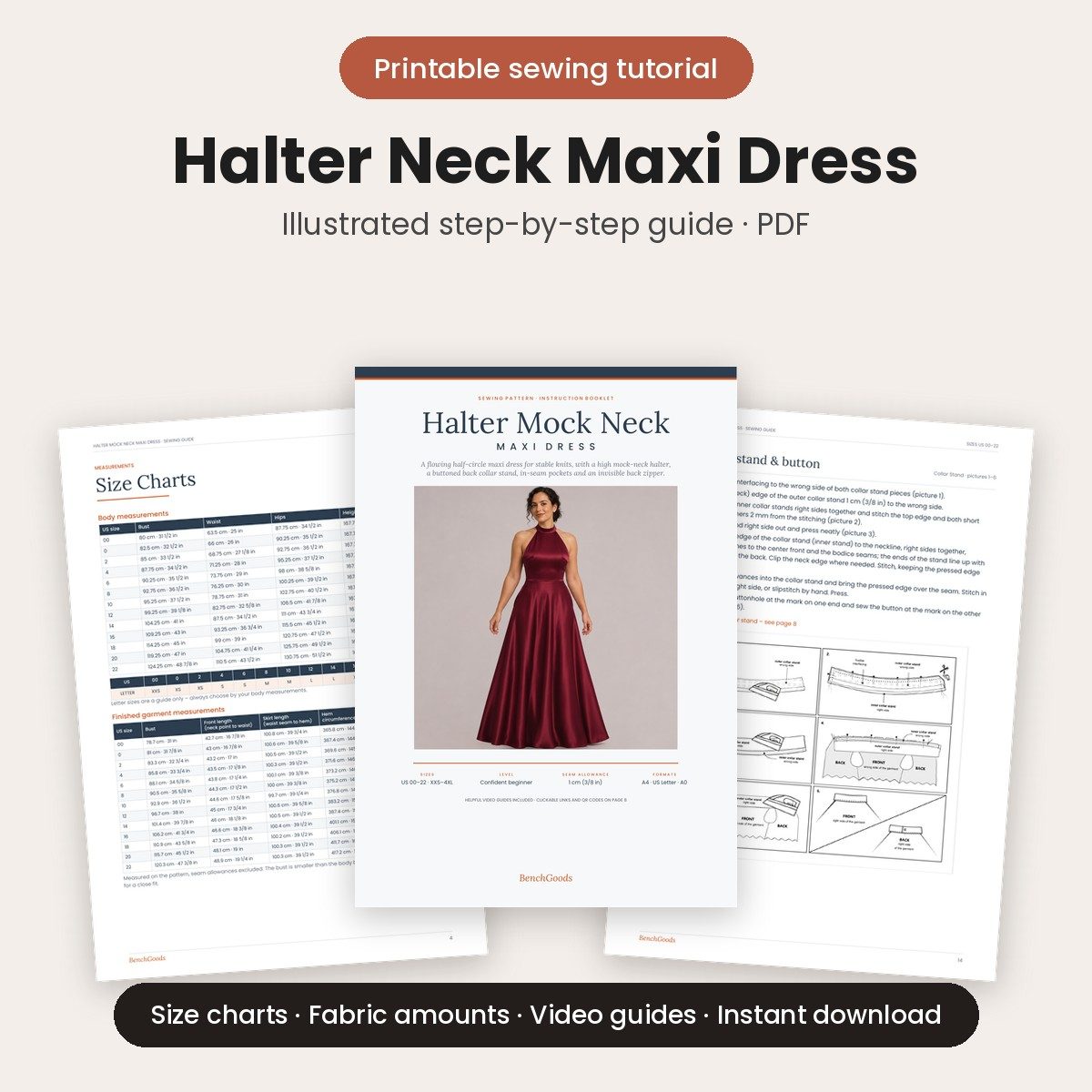
Get the full printable tutorial for the Halter Mock Neck Maxi Dress: detailed step-by-step sewing instructions with clear illustrations, line sketches, a sizing guide and the list of materials you need.
- Illustrated diagrams for every step, from the knit armholes to the buttoned collar stand
- Size charts, finished measurements and fabric amounts per size
- Video guides for the key techniques, with links and QR codes
- Printable PDF, instant download
Design details and fit of the Halter Maxi Dress
- High mock neck halter: the armholes sweep up to a narrow collar stand
- Collar stand closing at the back with one button and buttonhole
- Side bust darts for a smooth, fitted bodice
- Natural waist seam with an ankle-length half-circle skirt
- In-seam pockets in both skirt side seams
- Centre back invisible zipper, from the neckline into the skirt
- Clean armholes, turned and topstitched, with no facings
The pattern is drafted for a height of 168 cm (5′6″). The bodice has a little negative ease: the finished bust is slightly smaller than the body bust and the knit stretches to fit, so the dress hugs the bust and waist while the half-circle skirt flows freely. The skirt measures about 100 cm (39 3/8″) from the waist seam to the hem.
Sizing guide
Choose your size mainly by your bust measurement in the table below. If your waist falls in a different size, blend the side seams of the bodice and skirt waist between the two sizes. Your knit should stretch at least 20 % across: 10 cm of fabric should stretch to 12 cm without effort. Not sure? Read how to choose your size.
Letter sizes: 00 = XXS · 0/2 = XS · 4/6 = S · 8/10 = M · 12/14 = L · 16 = XL · 18 = 2XL · 20 = 3XL · 22 = 4XL
Body measurements
| cm | 00 | 0 | 2 | 4 | 6 | 8 | 10 | 12 | 14 | 16 | 18 | 20 | 22 |
|---|---|---|---|---|---|---|---|---|---|---|---|---|---|
| Bust | 80 | 82.5 | 85 | 87.8 | 90.2 | 92.8 | 95.2 | 99.2 | 104.2 | 109.2 | 114.2 | 119.2 | 124.2 |
| Waist | 63.5 | 66 | 68.8 | 71.2 | 73.8 | 76.2 | 78.8 | 82.8 | 87.5 | 93.2 | 99 | 104.8 | 110.5 |
| Hips | 87.8 | 90.2 | 92.8 | 95.2 | 98 | 100.2 | 102.8 | 106.5 | 111 | 115.5 | 120.8 | 125.8 | 130.8 |
Finished garment measurements
| cm | 00 | 0 | 2 | 4 | 6 | 8 | 10 | 12 | 14 | 16 | 18 | 20 | 22 |
|---|---|---|---|---|---|---|---|---|---|---|---|---|---|
| Bust | 78.7 | 81 | 83.3 | 85.8 | 88.1 | 90.5 | 92.9 | 96.7 | 101.4 | 106.2 | 110.9 | 115.7 | 120.3 |
| Front length | 42.7 | 43 | 43.2 | 43.5 | 43.8 | 44.3 | 44.6 | 45 | 46 | 46.6 | 47.3 | 48.1 | 48.9 |
| Skirt length | 100.8 | 100.6 | 100.5 | 100.3 | 100.1 | 100 | 99.7 | 100.6 | 100.5 | 100.4 | 100.2 | 100.3 | 100.3 |
| Hem | 365.8 | 367.4 | 369.6 | 371.6 | 373.2 | 375.2 | 376.8 | 383.2 | 387.4 | 401.1 | 406.1 | 411.7 | 417.2 |
Bust and hem are full circumferences of the finished dress. Front length is measured from the neck point to the waist seam; skirt length from the waist seam to the hem. Seam allowances excluded.
Fabric and notions
| cm | US 00–6 | US 8–14 | US 16–18 | US 20–22 |
|---|---|---|---|---|
| Main fabric, 150 cm wide | 290 | 310 | 330 | 350 |
| Main fabric, 115 cm wide | 350 | 400 | 430 | – |
| Pocket bags (lining) | 30 | 30 | 30 | 30 |
| Fusible interfacing, 90 cm wide | 30 | 30 | 30 | 30 |
Fabric amounts were calculated by laying out every pattern piece of each size, with the grainlines parallel to the selvedge and a little extra for shrinkage and straightening. Sizes 20–22 need 150 cm wide fabric. Buy a little more for stripes or one-way prints.
Common fit adjustments
Length. Take off or add the same amount all around the curved hem of both skirt pieces. For the bodice, adjust above the waist seam on the front and back by the same amount.
Bust and waist. Choose by the bust, then compare your waist to the chart: if it is in a different size, blend the side seams between the two sizes at the waist of the bodice and skirt.
Sewing notes
Fit & style
The bodice fits close and the half-circle skirt flows to the ankle. Try the bodice on after the side seams to check the armholes before finishing them.
Fabrics
Medium-weight stable knits with good recovery and a soft drape: ponte, crepe knit, or thick viscose or modal jersey. Avoid very thin, slippery jersey.
Cutting & sewing
Use pattern weights and a rotary cutter, a ballpoint or stretch needle and a narrow zigzag or an overlocker. Press with steam, lifting the iron.
Choosing fabric for a halter maxi dress
Ponte di Roma is the easiest choice: smooth and stable, it holds the collar stand and the invisible zipper without waves. A crepe knit gives a softer, matte drape that looks elegant at a wedding. For a flowing summer version, pick a thick viscose or modal jersey: the half-circle skirt will move beautifully with every step.
Do the stretch test before you buy: fold the fabric over 10 cm and pull it gently across the width. It should reach at least 12 cm and spring back. The skirt uses a lot of fabric, so check the width carefully, and pre-wash everything the way you will wash the dress.
Sewing steps
Seam allowance 1 cm (3/8″) unless stated otherwise. Sew with right sides together, using a narrow zigzag (0.5 to 1 mm wide, 2.5 mm long) or your machine’s stretch stitch, and finish the edges with an overlocker or a zigzag.
- Bust darts. On the front (1), stitch the bust darts from the side seam to the dart point, knot the thread tails and press the darts down. Staystitch the neckline of the front and both backs (3), 8 mm from the edge.
- Bodice side seams. Pin the front to each back at the side seams, matching the notches, and stitch. Finish and press open. The centre back edges stay open for the zipper.
- Armholes. Serge the armhole edge from the side seam up to the neckline, turn the 1 cm allowance to the wrong side and press. Topstitch with two rows 6 mm apart or a twin needle, or zigzag over the raw edge. A strip of fusible interfacing or clear elastic in the fold stops the armhole gaping.
- Pockets and skirt sides. Sew a pocket bag (5) to each side edge of the skirt front (2) and skirt backs (4), matching the pocket notches. Press the bags out and understitch. Pin the skirt front to the backs at the sides and stitch down to the pocket, around the pocket bag, then on down to the hem. Press the pockets toward the front.
- Skirt centre back. Stitch the two skirt backs together from the hem up to the zipper notch and backstitch. Baste above the notch to the waist, press open and finish the edges.
- Hem. Let the skirt hang for 24 hours, then level the hem 2 cm longer than the finished length. Turn up the 2 cm hem, press, and stitch with a zigzag or a twin needle.
- Skirt to bodice. Pin the skirt to the bodice at the waist, matching centre front, side seams and centre back edges. Stitch, stitch again 6 mm inside the seam allowance, finish and press toward the skirt. Clear elastic in the seam keeps the waist from stretching under the long skirt.
- Invisible zipper. Fuse a 2 cm interfacing strip to each centre back edge and unpick the basting. Press the zipper coils flat, then stitch each tape close to the coils with an invisible zipper foot, top stop 1 cm below the neck edge, matching the waist seams. Close the gap below the zipper and stitch the tape ends to the seam allowances.
- Collar stand and button. Fuse interfacing to both collar stand pieces (6) and press the neck edge of the outer stand 1 cm under. Stitch the stands together along the top and short ends, trim and turn. Sew the inner stand to the neckline, matching the notches, with the ends at the zipper edges. Fold the pressed edge over the seam and stitch in the ditch. Make a horizontal buttonhole on one end and sew the button on the other.
Tips and common mistakes
Gaping armholes? Never stretch the curve while sewing, and add a narrow strip of fusible interfacing or clear elastic in the fold before you topstitch.
Uneven hem. A circle skirt drops where it is cut across the grain. Always let it hang for a day before levelling the hem.
Wavy zipper? Always stabilise both centre back edges with interfacing strips before you set the zipper in a knit.
Neat collar stand. Clip the neck edge where it curves so the stand lies flat, and trim the corners close to the stitching before turning.
How to style the Halter Maxi Dress
Summer days: with flat sandals and a straw bag.
Weddings and evenings: with heeled sandals, a clutch and statement earrings.
Cooler nights: with a cropped cardigan, or a fitted blazer over the shoulders.
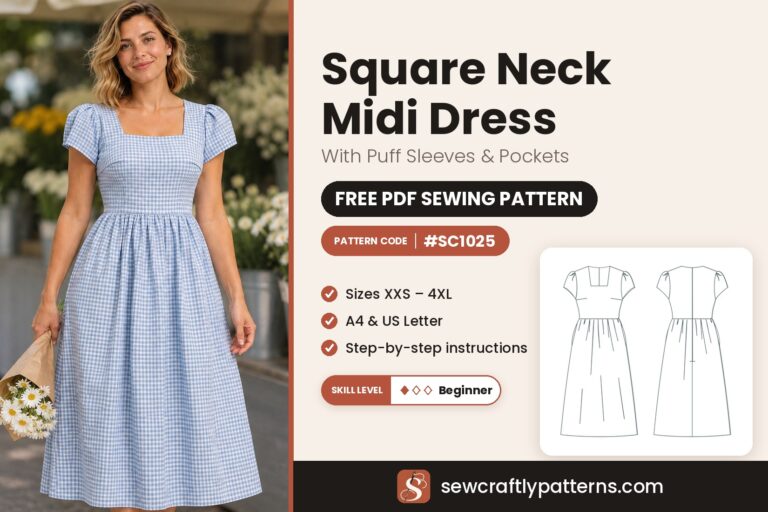
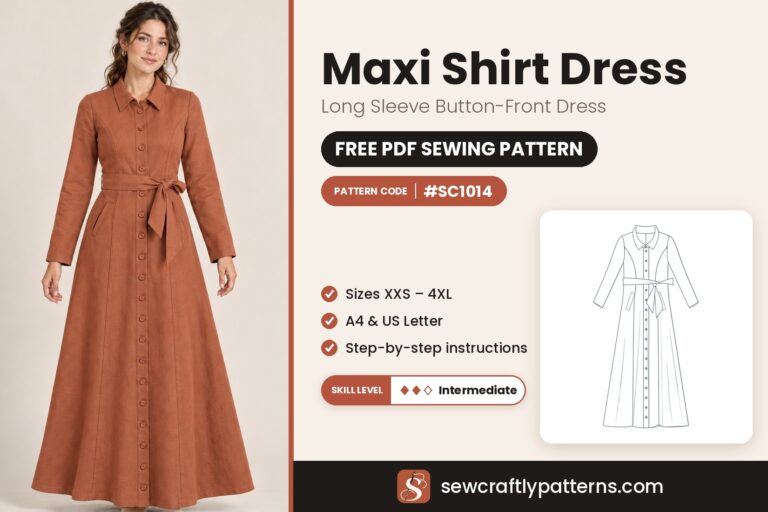
More dresses to sew: for a shorter knit dress with sleeves, try our square neck midi dress sewing pattern, or the maxi shirt dress sewing pattern for a button-front style.
Care
Wash cool on a gentle cycle, inside out with the zipper closed. Dry flat or folded over a rail: a long knit skirt can stretch on a hanger. Press with steam on the wrong side, lifting the iron.
More free maxi dresses: if you love a long summer dress, try our spaghetti strap dress sewing pattern, a lined maxi slip dress with a soft flared skirt.
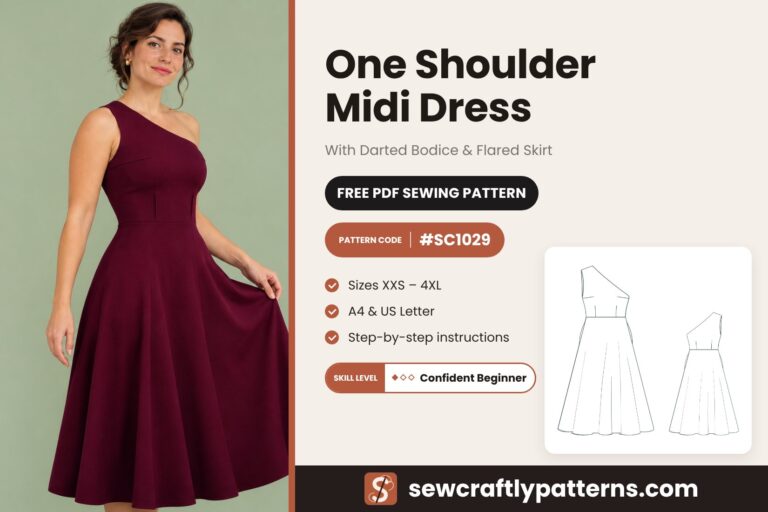
More free dresses: for a midi length in a woven fabric, try our one shoulder dress sewing pattern.
Questions
Is seam allowance included?
Yes: 1 cm (3/8″) on all seams and a 2 cm (3/4″) hem allowance on the skirt.
Which paper sizes are included?
The free download comes in A4 and US Letter, as a printable PDF with one file per size, XXS to 4XL (US 00–22).
Which size should I choose?
Choose mainly by your bust measurement, and blend to another size at the waist if needed.
Can I use a woven fabric?
The pattern is drafted for stable knits with at least 20 % stretch across. In a woven without stretch the bodice would be too tight, because it has negative ease.
How much fabric do I need?
About 2.9 to 3.5 m of 150 cm wide fabric, or 3.5 to 4.3 m of 115 cm wide for sizes 00 to 18, plus 0.3 m of lining for the pocket bags. See the fabric table above.
Can I make it shorter?
Yes. Take the same amount off all around the curved hem of both skirt pieces for a midi or knee-length version.
Can I sew it without an overlocker?
Yes. A narrow zigzag works for every seam, with a ballpoint or stretch needle, and a twin needle or zigzag for the armholes and hem.
Is this dress good for beginners?
Yes, for a confident beginner. The invisible zipper and the collar stand ask for a little patience; everything else is straightforward.
Happy sewing!
Love our free patterns? Buy us a coffee to keep them coming, or simply share, pin and comment. Thank you!
 Support me on Ko-fi