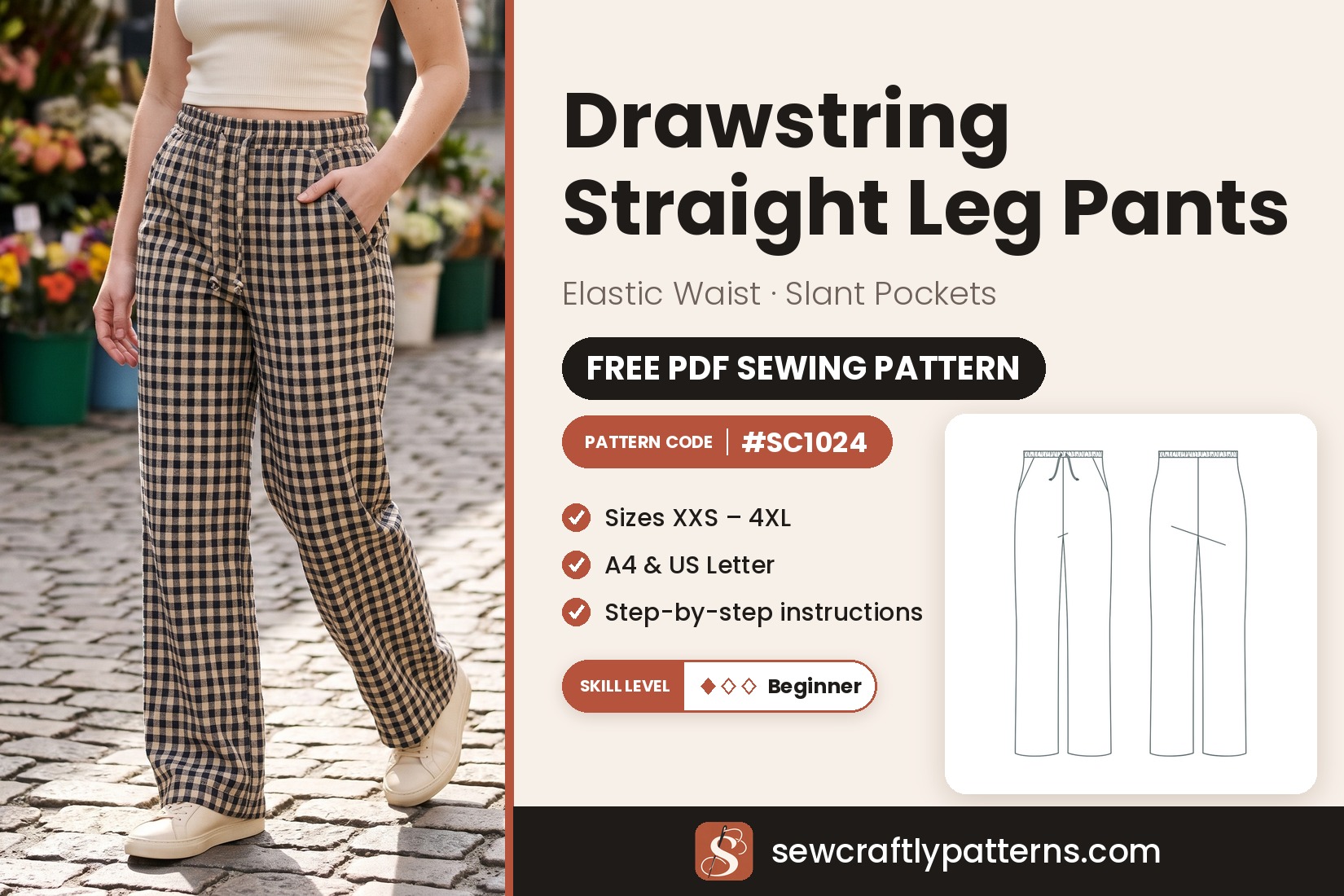
Garment Straight leg drawstring pants
Level Easy · confident beginner
Sizes XXS – 4XL
Fabric Knits or stretch wovens
Pieces 7
These drawstring pants are the easy pull-on pair you reach for every weekend: a relaxed straight leg, two slant front pockets deep enough for your phone, and a soft elastic waistband with a cord that ties at the front. No zip, no buttons, no darts, just comfort that still looks put together.
This free drawstring pants sewing pattern is drafted for fabrics with stretch, like ponte, French terry or a stretch gingham seersucker like the pair in our photos. The back is simple and the waistband is sewn on in one go, so it is a quick and satisfying project for a confident beginner. You will practise slant pockets with a facing, a casing with elastic, and two little eyelets for the drawstring.
Materials
- Main fabric: 1.4 to 1.9 m (1 5/8 to 2 1/8 yd) of 150 cm wide fabric, or 2.4 to 2.5 m (2 5/8 to 2 3/4 yd) of 115 cm wide, depending on your size: ponte, French terry, double knit, heavy jersey or a stretch woven with elastane (see the fabric table below)
- Pocket bags: 0.3 m (3/8 yd) of cotton lawn, poplin or light jersey
- Elastic 3.3 cm (1 1/4″) wide, 53 to 91 cm long depending on your size
- Drawstring cord 5 to 8 mm (about 1/4″), 91 to 111 cm long
- 2 metal eyelets 7 mm (1/4″) with their setting tool, or 2 small buttonholes instead
- A small piece of light fusible interfacing, 15 × 10 cm (6 × 4″)
- Polyester thread, a ballpoint or stretch needle, and a safety pin or bodkin
Pattern pieces
- 1 Pants front, main fabric: cut 2 (a mirrored pair)
- 2 Pants back, main fabric: cut 2 (a mirrored pair)
- 3 Waistband, main fabric: cut 1, single layer, opened flat
- 4 Pocket facing, main fabric: cut 2 (a mirrored pair)
- 5 Pocket bag big, lining: cut 2 (a mirrored pair)
- 6 Pocket bag small, lining: cut 2 (a mirrored pair)
- 7 Waistband interfacing: cut 1
Fold the fabric selvage to selvage so the greatest stretch goes around the body. The waistband is drawn whole: cut it from a single layer, with the stretch along its length. In size 22 the waistband comes in two pieces (front and back), so the next pieces move up one number.
New to PDF patterns? Start here
Our free step-by-step guides take you from your measurements to a printed pattern:
- How to take your body measurements: what to measure and how, in 10 minutes.
- How to choose your size: which measurement to follow, and what to do between sizes.
- How to print and assemble your pattern: A4 or US Letter, the test box, and taping the pages.
Get the pattern
Free PDF pattern, with one file per size, XXS to 4XL (US 00–22). Share your make with #sewcraftly!
Print page 1 at 100% and check that the test square measures 10 cm (4 in). New to PDF patterns? Read how to print and assemble a PDF pattern.
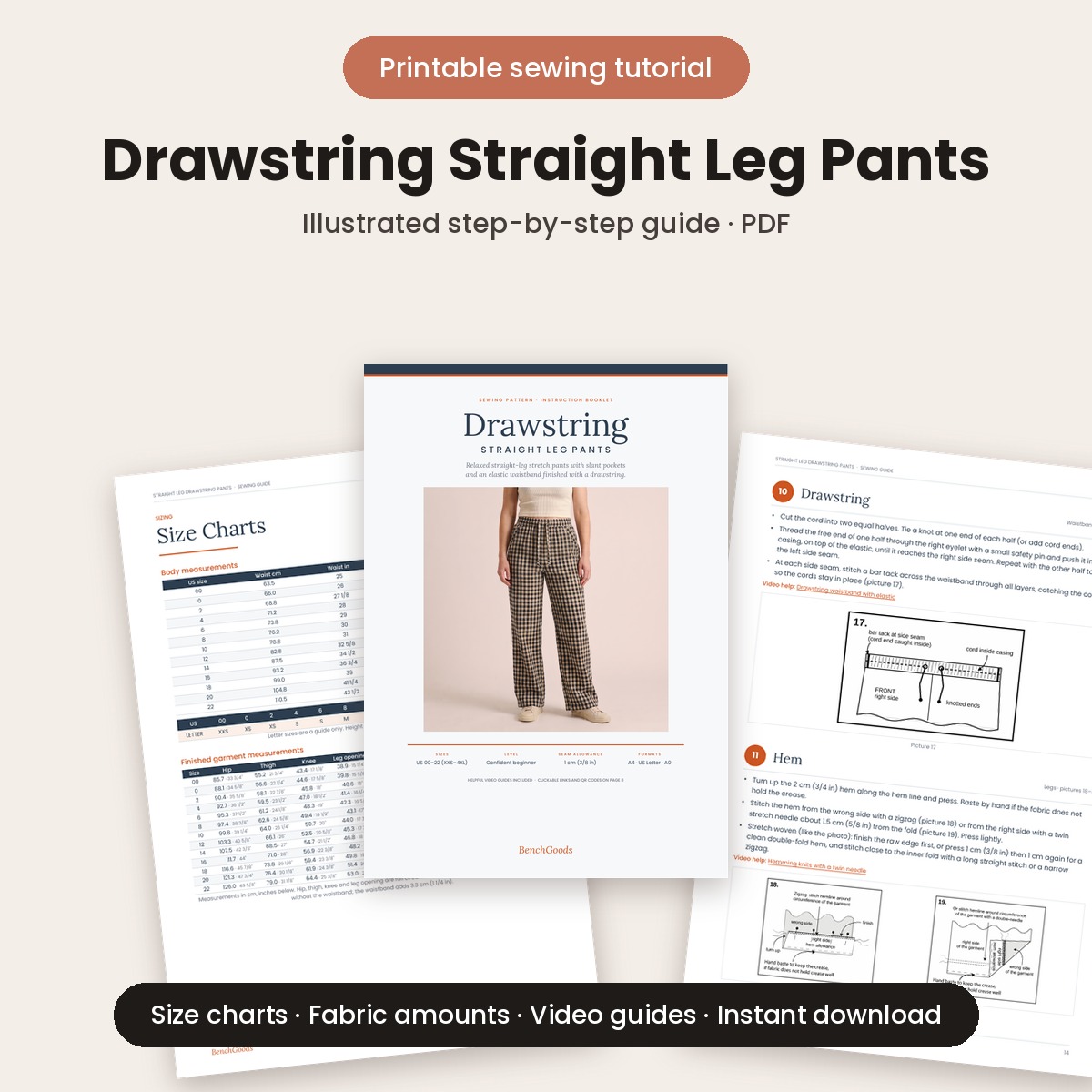
Printable sewing tutorial
Need help completing the project?
Get the full printable tutorial for the Drawstring Straight Leg Pants: detailed step-by-step sewing instructions with clear illustrations, line sketches, a sizing guide and the list of materials you need.
- Illustrated diagrams for every step, from the slant pockets to the drawstring waistband
- Size charts, finished measurements, fabric, elastic and cord amounts per size
- Video guides for the key techniques, with links and QR codes
- Printable PDF, instant download
Design details and fit of the Drawstring Pants
- Relaxed straight leg with a full-length inseam
- Two slant front pockets with a fabric facing inside the opening
- Separate 3.3 cm (1 1/4″) elastic waistband, sewn on in one step
- Drawstring cord that comes out through two eyelets at the centre front
- Simple back with no darts and no closure: a true pull-on fit
The pattern is drafted for a height of 168 cm (5′6″). It fits close at the hips: the finished hip is slightly smaller than the body hip, and the stretch of the fabric does the rest. That is why the fabric must stretch at least 20 % across, so the waistband can slide over your hips.
Sizing guide
Drafted for a height of 168 cm (5′6″). Choose your size by your hip measurement in the table below. If your fabric stretches less than 20 % across, go up one size. Not sure? Read how to choose your size.
Letter sizes: 00/0 = XXS · 2/4 = XS · 6/8 = S · 10/12 = M · 14 = L · 16 = XL · 18 = XXL · 20 = 3XL · 22 = 4XL
Body measurements
| cm | 00 | 0 | 2 | 4 | 6 | 8 | 10 | 12 | 14 | 16 | 18 | 20 | 22 |
|---|---|---|---|---|---|---|---|---|---|---|---|---|---|
| Waist | 63.5 | 66 | 68.8 | 71.2 | 73.8 | 76.2 | 78.8 | 82.8 | 87.5 | 93.2 | 99 | 104.8 | 110.5 |
| Hips | 87.8 | 90.2 | 92.8 | 95.2 | 98 | 100.2 | 102.8 | 106.5 | 111 | 115.5 | 120.8 | 125.8 | 130.8 |
Finished garment measurements
| cm | 00 | 0 | 2 | 4 | 6 | 8 | 10 | 12 | 14 | 16 | 18 | 20 | 22 |
|---|---|---|---|---|---|---|---|---|---|---|---|---|---|
| Hip | 85.7 | 88.1 | 90.4 | 92.7 | 95.3 | 97.4 | 99.8 | 103.3 | 107.5 | 111.7 | 116.6 | 121.3 | 126 |
| Thigh | 55.2 | 56.6 | 58.1 | 59.5 | 61.2 | 62.6 | 64 | 66.1 | 68.5 | 71 | 73.8 | 76.4 | 79 |
| Knee | 43.4 | 44.6 | 45.8 | 47 | 48.3 | 49.4 | 50.7 | 52.5 | 54.7 | 56.9 | 59.4 | 61.9 | 64.4 |
| Leg opening | 38.9 | 39.8 | 40.6 | 41.4 | 42.3 | 43.1 | 44 | 45.3 | 46.8 | 48.2 | 49.8 | 51.4 | 53 |
| Front rise | 25.8 | 26.2 | 26.6 | 27.1 | 27.5 | 28 | 28.4 | 29.1 | 29.9 | 30.7 | 31.6 | 32.4 | 33.2 |
| Back rise | 34.3 | 34.9 | 35.6 | 36.3 | 37 | 37.6 | 38.3 | 39.3 | 40.4 | 41.6 | 42.9 | 44.5 | 45.8 |
| Inseam | 74.7 | 74.3 | 73.9 | 73.5 | 73.1 | 72.8 | 72.4 | 71.8 | 71.2 | 70.5 | 69.8 | 69.1 | 68.4 |
| Side length | 100.6 | 100.5 | 100.5 | 100.5 | 100.4 | 100.4 | 100.3 | 100.3 | 100.2 | 100.1 | 100 | 99.8 | 99.7 |
Hip, thigh, knee and leg opening are full circumferences of the finished pants. Rise and side length are measured without the waistband, which adds 3.3 cm (1 1/4″).
Fabric, elastic and cord
| cm | US 00–6 | US 8–14 | US 16–22 |
|---|---|---|---|
| Main fabric, 150 cm wide | 140 | 140 | 190 |
| Main fabric, 115 cm wide | 240 | 240 | 250 |
| Pocket bags (lining) | 30 | 30 | 30 |
| cm | 00 | 0 | 2 | 4 | 6 | 8 | 10 | 12 | 14 | 16 | 18 | 20 | 22 |
|---|---|---|---|---|---|---|---|---|---|---|---|---|---|
| Elastic | 53.2 | 55.2 | 57.4 | 59.4 | 61.4 | 63.4 | 65.4 | 68.6 | 72.4 | 77 | 81.6 | 86.2 | 90.8 |
| Cord | 91 | 92 | 93 | 94 | 96 | 97 | 98 | 100 | 102 | 104 | 106 | 108 | 111 |
Fabric amounts were estimated by laying out the real pattern pieces of each size, plus about 8 % for shrinkage and straightening. Allow extra for napped fabrics or to match checks. The elastic length is also printed on the waistband piece; the cord is cut in two equal halves.
Common fit adjustments
Length. Add or remove length at the hem, or cut the legs across between the knee notch and the hem and spread or overlap evenly, then true the side and inseam edges.
Waist comfort. The elastic is threaded in before the gap is closed, so you can try the pants on and shorten or lengthen it until it feels right.
Sewing notes
Fit & style
Choose by the hip: the pants fit close there and relax down the leg. Try them on after the side seams and check the length before the waistband.
Fabrics
Medium-weight knits with good recovery (ponte, French terry, double knit) or stretch wovens with elastane. Avoid wovens without stretch.
Cutting & sewing
Use a ballpoint or stretch needle and a narrow zigzag or stretch stitch. Test a seam, the interfacing and one eyelet on a scrap first.
Choosing fabric for drawstring pants
For an everyday pair, ponte di Roma is the easiest choice: it is stable, does not curl and keeps a neat straight leg. French terry makes the cosiest version for travel and lounge days, and a heavy jersey or interlock gives a softer, drapier pant. If you prefer the look of a woven, pick one with elastane, like the stretch gingham seersucker in our photos or a stretch linen-viscose.
Do the stretch test before you buy: fold the fabric over 10 cm and pull it gently across the width. It should reach at least 12 cm and spring back. For the pocket bags, a light cotton lawn or poplin keeps the front smooth, and pre-wash everything the way you will wash the pants.
Sewing steps
Seam allowance 1 cm (3/8″) unless stated otherwise. Sew with right sides together, using a stretch stitch or a narrow zigzag (width 0.5 to 1, length 2.5 to 3), and finish the edges with an overlocker or a zigzag.
- Slant pockets. Sew the slanted edge of the small pocket bag (6) to the pocket edge of the front (1), right sides together. Understitch the lining about 3 mm from the seam, turn it inside, press and topstitch the opening 6 mm from the edge. Zigzag the pocket facing (4) onto the big pocket bag (5), lay it under the front so the facing shows through the opening, matching the marks, and sew the two bags together around the curve. Baste the pocket to the front at the waist and side. Repeat on the other front.
- Inseams. Pin each front to a back (2) along the inner leg, matching the knee notches. Stitch from the crotch to the hem, finish and press toward the back.
- Crotch seam. Turn one leg right side out and slip it inside the other, right sides together, matching the inseams and notches. Stitch from the back waist to the front waist, then reinforce the curve with a second row 6 mm away, trim and finish.
- Side seams. Pin the side edges, matching the notches and the pocket corner, and check that the pocket bag lies flat. Stitch from the waist to the hem, finish and press toward the back. Try the pants on and check the length.
- Eyelets. Fuse the interfacing (7) on the wrong side of the waistband (3) over the eyelet marks at the centre front. Set the two 7 mm eyelets on the marks from the right side, or sew two small vertical buttonholes about 1 cm long.
- Waistband loop. Sew the short ends of the waistband together to make a loop, leaving a 4 cm gap on the half without eyelets to insert the elastic. Press the seam open, then fold the loop in half along the fold line, wrong sides together, and baste the raw edges.
- Attach the waistband. Slip the waistband over the pants, right sides together, with the eyelet layer against the pants. Match the centre front, centre back and side marks, with the waistband seam at the left side. Stitch, stitch again 6 mm inside the seam allowance, trim, finish and press down toward the pants.
- Elastic. Cut the elastic for your size and thread it through the gap all around the casing with a safety pin, keeping it flat. Overlap the ends 2 cm, try the pants on, adjust, then zigzag the overlap securely.
- Close the gap. Let the elastic slip inside and slipstitch the gap closed. Spread the gathers evenly and stitch in the ditch of the centre back seam through all layers so the elastic cannot twist.
- Drawstring. Cut the cord in two halves and knot one end of each. Push the free end of one half through the right eyelet and along the casing, on top of the elastic, to the right side seam; repeat on the left. Bar tack across the waistband at each side seam, catching the cord end.
- Hem. Turn up the 2 cm hem and press. Stitch from the wrong side with a zigzag, or from the right side with a stretch twin needle 1.5 cm from the fold. For a stretch woven, press 1 cm and 1 cm again for a double-fold hem and stitch close to the inner fold.
Tips and common mistakes
Do not stretch the pocket opening. The slanted edge is cut on the bias and stretches easily: handle it gently, and topstitch without pulling so the pocket does not gape.
Eyelets before the loop. Set the eyelets while the waistband is still flat. Once it is sewn into a loop and attached, it is much harder to reach.
Elastic twisting in the wash? The stitch in the ditch at the centre back and the bar tacks at the sides keep everything in place. Add one at the centre front too, between the eyelets, if you like.
Matching checks. With gingham or stripes, line up the pattern pieces on the same check at the hip and knee notches before cutting, and buy a little extra fabric.
How to style the Drawstring Pants
Everyday: with a fitted top and white sneakers, like our long sleeve tee sewing pattern in a plain rib knit.
Relaxed office: a tucked-in button up shirt and loafers.
Travel and lounge: a pair in French terry with a cropped sweater.
More pants to sew: for a woven pair with more volume, try our wide leg pants sewing pattern.
Care
Wash inside out at 30 °C (86 °F) on a gentle cycle. Dry flat or tumble dry on low. Press with a pressing cloth and do not put the iron directly on the eyelets.
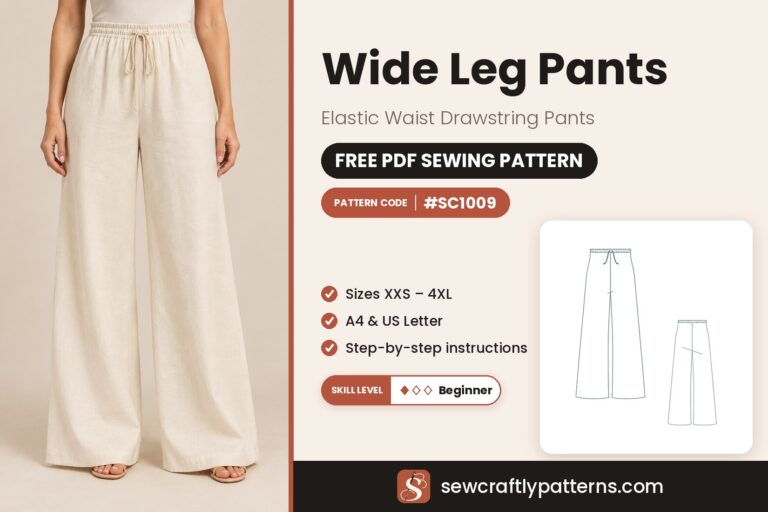
Prefer a wider leg? Try our free wide leg pants sewing pattern: easy pull-on knit pants with an elastic waist and a front tie.
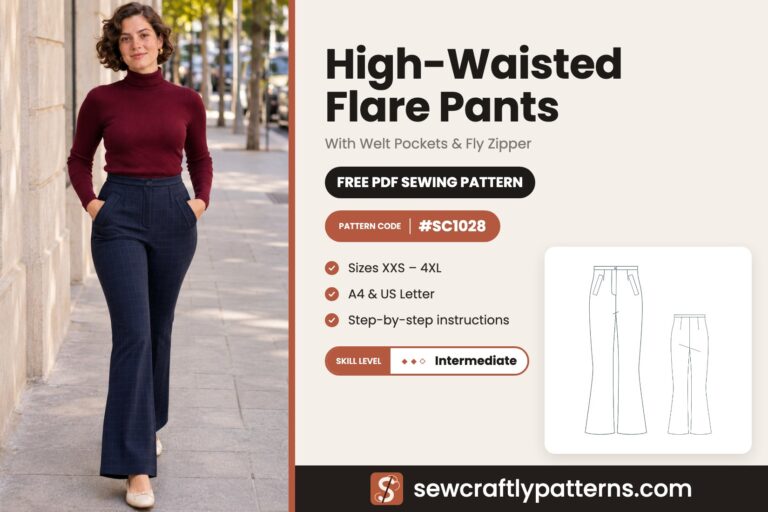
More free pants: for a tailored pair, try our flare pants sewing pattern, high-waisted with welt pockets and a fly zipper.
Questions
Is seam allowance included?
Yes: 1 cm (3/8″) on all seams and a 2 cm (3/4″) hem allowance on the legs.
Which paper sizes are included?
The free download comes in A4 and US Letter, as a printable PDF with one file per size, XXS to 4XL (US 00–22).
Which size should I choose?
Choose by your hip measurement. If you are between sizes, follow the hip, and if your fabric stretches less than 20 % across, go up one size.
Can I use a woven fabric?
Only a woven with elastane that stretches at least 20 % across, like stretch seersucker or stretch linen-viscose. A woven without stretch will not slide over the hips.
How much fabric do I need?
About 1.4 to 1.9 m of 150 cm wide fabric, or 2.4 to 2.5 m of 115 cm wide, plus 0.3 m of lining for the pocket bags. See the fabric table above.
I do not have an eyelet tool. What can I do?
Sew two small vertical buttonholes, about 1 cm (3/8″) long, on the eyelet marks instead. Remember to interface the waistband there first.
Can I sew it without an overlocker?
Yes. A narrow zigzag or your machine’s stretch stitch works for every seam, with a ballpoint or stretch needle.
Are these pants good for beginners?
Yes, for a confident beginner. The slant pockets and the waistband with elastic and cord ask for a little care, and everything else is straight seams.
Happy sewing!
Love our free patterns? Buy us a coffee to keep them coming, or simply share, pin and comment. Thank you!
 Support me on Ko-fi