The fabric you pick changes everything: how a garment hangs, how it feels, and how easy it is to sew. The same pattern can look crisp in cotton twill and fluid in viscose. This guide shows you how to tell fabrics apart, how to match them to a pattern, and how to prepare them before you cut.
Time 10 min read
Level Beginner
For Dresses, pants, jackets, skirts & tops
You need Your pattern’s fabric list
1. Woven or knit?
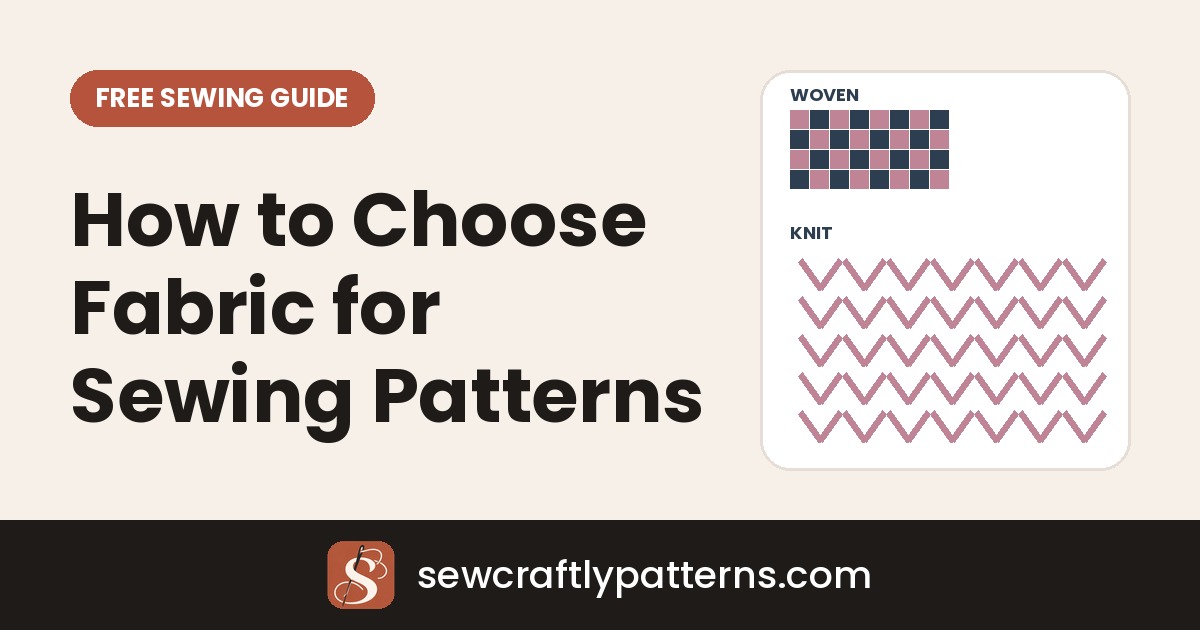
This is the first thing to check, because the two behave very differently. Woven fabrics are made from threads that cross at right angles, so they barely stretch and they fray at the cut edge. Knit fabrics are made from interlocking loops, so they stretch and do not fray. A pattern drafted for one will not work in the other.
Quick test: pull the fabric gently in both directions. If it hardly gives, it is woven. If it stretches and springs back, it is a knit. Our free patterns say which one they are made for in the Materials section, so always read it before you buy.
2. Fabric weight: light, medium or heavy
Weight is how heavy the fabric is for its size, and it is usually written in g/m² (grams per square metre) or oz/yd². It tells you how the garment will hang and what it can do.
- Light: soft, floaty and see-through. Good for blouses, summer dresses and linings. It can be slippery to cut and sew.
- Medium: the easiest weight to sew. Good for most dresses, skirts, shirts, pants and unlined jackets.
- Heavy: structured and warm. Good for jackets, coats, jeans and pinafores. Thick seams need a stronger needle and slower sewing.
3. Common fabrics at a glance
| Fabric | Type | Feel | Great for | Watch out for |
|---|---|---|---|---|
| Cotton poplin | Woven, light to medium | Crisp, smooth | Shirts, dresses, skirts | Creases easily |
| Linen / linen blend | Woven, medium | Dry, airy, textured | Summer dresses, pants, jackets | Wrinkles and frays a lot |
| Viscose / rayon | Woven, light to medium | Soft, fluid drape | Maxi dresses, wide-leg pants, blouses | Slippery; shrinks when washed |
| Crepe | Woven, light to medium | Matte, flowing | Dresses, pants, tops | Can be slippery to cut |
| Cotton twill | Woven, medium to heavy | Sturdy, a little body | Pants, jackets, pinafores | Heavier seams |
| Denim | Woven, medium to heavy | Firm, hard-wearing | Jeans, jackets, skirts | Needs a denim needle |
| Corduroy | Woven, medium to heavy | Warm, ribbed pile | Pinafores, jackets, pants | Has a nap: cut all pieces in one direction |
| Wool flannel / suiting | Woven, medium | Warm, holds its shape | Jackets, vests, skirts | Needs steam pressing |
| Jersey | Knit, light to medium | Soft, stretchy | T-shirts, fitted dresses | Needs a stretch needle; edges curl |
| Cotton-spandex knit | Knit, medium, 4-way stretch | Stretchy, holds its shape | Biker shorts, leggings | Check the stretch percentage |
4. Match the fabric to the garment
Every pattern is drafted with a certain fabric in mind. Follow its fabric list, and use the table below as a starting point.
| Garment | Best fabrics | Avoid |
|---|---|---|
| Dresses | Viscose, crepe, poplin, linen blend, light twill | Very stiff or very thick fabrics |
| Pants | Twill, linen blend, crepe, viscose twill, light denim | Sheer or very light fabrics (they show through) |
| Shorts | Cotton-spandex knit for fitted styles; twill or linen for woven styles | Knits for a pattern drafted for woven fabric |
| Jackets | Twill, denim, wool flannel, suiting, heavy linen | Floppy fabrics with no body |
| Skirts | Poplin, twill, crepe, linen, corduroy | Fabrics that cling or lose shape |
| Tops | Poplin, viscose, crepe, lawn, light linen | Heavy fabrics that make bulky seams |
See it in practice: our button front pinafore dress works in fine corduroy or twill, our wide leg pants look best in a fabric with drape, and our high waisted biker shorts need a stretch knit.
5. Understand the grain
The selvage is the tightly woven edge on each side of a woven fabric. The threads running parallel to it are the lengthwise grain: the strongest direction, with the least stretch. The threads across it are the crosswise grain, with a little more give. The diagonal at 45° is the bias, which stretches the most.
On every pattern piece you will see a long arrow: the grainline. Lay the piece so the arrow runs parallel to the selvage (measure from the arrow to the selvage at both ends, and the distance should match). A piece cut off grain will twist and hang badly after washing.
6. How much fabric to buy
- Check the width. Fabric is usually 115 cm (45″) or 150 cm (60″) wide. Our patterns list the amount for both, so pick the one that matches your fabric.
- Add about 8 % for shrinkage and straightening if the amount does not already include it.
- Allow extra for a nap or a print. Corduroy, velvet and one-way prints need every piece to face the same direction. Stripes and large prints need extra for matching.
- Do not forget the extras: lining, interfacing, zipper, buttons and thread.
7. Prepare your fabric before cutting
Four steps
- Pre-wash the fabric the same way you will wash the finished garment. Most fabrics shrink the first time.
- Dry it as you will dry the garment, then shake it out.
- Press it flat with the right heat for the fibre, so there are no creases when you cut.
- Straighten the grain: fold it lengthwise with the selvages together and check that the cut ends line up. If they do not, gently pull the fabric on the diagonal until they do.
8. Needle and thread for your fabric
| Fabric | Needle | Stitch length |
|---|---|---|
| Light wovens (voile, chiffon) | Universal 60/8 to 70/10 | 2 to 2.5 mm |
| Medium wovens (poplin, linen, crepe) | Universal 80/12 | 2.5 mm |
| Heavy wovens (twill, corduroy) | Universal 90/14 | 2.5 to 3 mm |
| Denim and canvas | Jeans needle 90/14 to 100/16 | 3 mm |
| Stretch knits | Stretch or ballpoint 75/11 to 90/14 | Small zigzag or stretch stitch |
Tip: always sew a test seam on a scrap of your real fabric first. Change the needle after about 8 hours of sewing or when it starts skipping stitches.
Common mistakes to avoid
- Using a knit for a woven pattern, or the other way round. The fit will be completely different.
- Skipping the pre-wash. A dress that fits perfectly can shrink a size on its first wash.
- Choosing a fabric that is too sheer or too heavy. Hold it up to the light, and drape it over your arm to see how it hangs.
- Ignoring the nap. A piece cut upside down in corduroy looks like a different colour.
- Buying before testing. Start with a small amount, or sew a test version in cheaper fabric first.
Questions
What is the best fabric for a beginner?
A medium-weight cotton such as poplin or lightweight twill. It is stable, easy to cut, easy to press and forgiving to sew. Avoid very slippery, sheer or stretchy fabrics for your first projects.
Can I use a knit fabric for a pattern made for woven fabric?
Usually not. Patterns for woven fabric have no stretch built in, so a knit would change the fit and can stretch out of shape. Follow the fabric list of the pattern.
Do I really need to pre-wash fabric?
Yes. Pre-washing removes the finish, shows how much the fabric shrinks and checks that the colours do not run, before you spend time sewing.
How do I find the right side of the fabric?
The right side is usually smoother, brighter or more printed. On a bolt, the fabric is often folded with the right side inside. If you cannot tell, pick one side, use it for every piece and be consistent.
What does GSM mean on fabric?
GSM means grams per square metre. It is a measure of fabric weight: the higher the number, the heavier and thicker the fabric.
Fabric chosen? Take your measurements, choose your size, then print your pattern.